








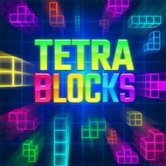
Tetra Blocks
 (Пока оценок нет)
 Loading...
Similar Games





Description
Tetra Blocks looks like a straightforward line-clearing puzzle at first glance, but the glowing stars embedded inside certain pieces do not work the way most players assume — they aren’t just decoration, and ignoring them is the fastest way to plateau at a mediocre score.
| Genre | Falling-block puzzle |
| Developer | Ravalmatic |
| Controls | Arrow keys or WASD to move/rotate, spacebar to hard-drop |
| Objective | Clear horizontal lines by filling them completely |
The Star Mechanic That Sets Tetra Blocks Apart
On the surface, Tetra Blocks plays like any classic line-clearing puzzle game: shapes made of four connected squares fall from the top of the grid, and arranging them into complete horizontal rows clears those rows and scores points. What separates Tetra Blocks from the dozens of similar games in this genre is that some pieces contain glowing stars embedded inside them, and clearing a line that includes multiple stars boosts your score considerably more than a plain line clear.
This changes the calculus of how you play. A player focused purely on speed will clear lines the moment they’re available, but a player chasing a high score often waits, deliberately stacking pieces to align several star blocks into the same row before triggering the clear. That patience carries real risk, though — waiting too long on a crowded board in the later levels can mean the stack reaches the top before you get the alignment you wanted.
Clearing up to four lines simultaneously is possible if you manage your stack correctly, and one common technique among experienced players involves leaving a single vertical column open on the left or right edge specifically to slot in a long, thin piece for a four-line clear. It’s a technique borrowed conceptually from other games in the genre, but the star mechanic gives it extra weight here since a four-line clear packed with stars produces a genuinely huge score spike.
Controls and Early-Game Habits in Tetra Blocks
Movement uses the arrow keys or WASD, with the up arrow or W rotating the falling piece 90 degrees clockwise. The down arrow speeds up the drop, while the spacebar performs a hard drop that instantly sends the piece to the bottom of the grid. That hard drop is powerful but should be used carefully — it commits you to a placement immediately, with no chance to adjust once you’ve already seen where it’s about to land.
- Rotating a piece before it’s fully visible, rather than waiting to see its full shape, often leads to placement mistakes.
- Beginners tend to overuse the hard drop out of impatience, which removes the ability to make small last-second adjustments.
- Watching the upcoming three pieces shown on the side of the screen lets you plan two or three moves ahead rather than reacting one piece at a time.
Early levels move slowly enough that players can afford to prioritize big scores over speed, but the drop rate accelerates significantly as the level counter climbs. By the time you’re several levels deep, clearing any available line quickly becomes more important than holding out for a perfect star alignment, since the falling speed leaves less room for deliberate stacking.
What Divides Players About Tetra Blocks
A recurring point of discussion among players is whether the star mechanic actually adds strategic depth or simply encourages risky stalling that occasionally backfires when the board fills up unexpectedly fast. Some treat star-hunting as the entire appeal of the game, while others play it more like a traditional line-clearer and largely ignore the stars in favor of consistent, safer clears. Both camps exist comfortably within the same community, and which approach suits you largely comes down to whether you value peak scores over steady survival.
Frequently Asked Questions
How do the star blocks in Tetra Blocks affect scoring?
Clearing a line that contains one or more star-marked blocks awards significantly more points than a standard line clear, which is why experienced players sometimes delay clearing a line to first stack multiple star pieces into the same row.
What is the maximum number of lines I can clear at once?
Up to four lines can be cleared simultaneously, typically achieved by leaving a single open column on one edge of the grid and dropping a long piece into it once several rows are otherwise complete.
Does the falling speed increase as I progress?
Yes, the drop speed increases with each level, meaning the deliberate, patient stacking strategy that works well early on becomes riskier and eventually impractical once pieces start falling considerably faster.
Tetra Blocks takes a familiar formula and adds just enough of a twist with its star mechanic to reward players who think a few moves ahead rather than clearing lines reflexively. Whether you’re chasing a four-line star combo or simply trying to survive one more level, the neon-lit grid keeps the pressure building the same way it always has in this genre.