






Swaggerfall
 (1 оценок, среднее: 5.00 из 5)
 Loading...
Similar Games



Description
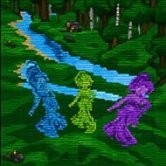
Eating in Swaggerfall does not sit outside the progression system, it is one more action that grants xp, right beside sprinting, jumping, climbing, mining, smelting and cooking. That one detail explains the whole design of this first-person open-world fantasy RPG, which plays in a terminal and draws its entire world with ASCII glyphs and colored backgrounds. Getting comfortable with a few keys and a lot of small habits is the real skill in the game.
| Genre | First-person open-world fantasy RPG |
| Look | ASCII graphics in a terminal |
| Combat | Turn-based with quick time events |
| World | Procedurally generated and infinite |
| Controls | WASD to move, arrow keys to look |
| Status | Open alpha |
Every Action Grants xp: Sprinting, Mining, Cooking and Eating in Swaggerfall
Nothing you do is wasted here. Sprinting, jumping, climbing, mining, smelting, cooking and even eating all feed your skills, so a sprint across a village or a quiet meal by a campfire still moves a bar forward. Fighting works the same way, but it also teaches you about the enemy race in front of you, which makes later battles easier and opens up more interactions. Fight enough of one race and you can tell them to leave you alone.
The controls stay small. WASD moves you, the arrow keys look around, Space jumps, and the E key does dozens of jobs depending on context, from chopping and mining to talking and hunting.
R eats and drinks, and Tab opens an action menu that leads to every other screen and lists its keybinds. Players who love watching skill bars climb from ordinary chores will find the loop addictive, while anyone who wants a clear list of objectives at all times may feel a little unguided in the alpha.
Coyote Time, Ledge Grabs and the Parkour Side of Swaggerfall
The jump is more forgiving than it first appears. Coyote time keeps you from dropping off a building too early when you meant to leap, and your ledge grab tolerance grows as you get better at jumping. That means movement is a skill line in its own right, not just a way to get from one town to the next.
Even a jump that lands two pixels short of a roof can still catch the edge and keep you running, which changes how you look at rooftops in cities and towns. Early in the game, before your ledge grab tolerance has grown, expect to miss more edges than you catch.
Explorers who like a first-person world that rewards vertical movement will spend many sessions climbing things just to see how far the skill carries them. It is a small system, but it gives the ASCII world a physical feel that few terminal games try to match.
Quick Time Events, Parry Windows and the Shadow Counter
Combat is turn-based, but it is not passive. Quick time events on Space let you hit, parry and dodge, so every exchange asks for timing as well as the right skill choice. Fans of turn-based fights with active input will enjoy the parry windows, since a perfect parry feels like a real payoff.
The shadow counter is where new players stumble. Shadow strikes have to be countered with C instead of Space, and you press it when the bar turns purple. The game only explains this during the attack itself, and the moment is hectic enough that many newcomers miss it, which is a flaw already on the list of known issues.
Other rough edges are worth knowing about. Quick time events sometimes fail even when they seem to land perfectly, possibly because of groups of enemies with different timings or a level-up that shifts the windows, and the feedback on crits and parries is not always clear. Some combat sounds are still placeholder blips, which is most noticeable during ultimates.
Wyrdness, Chaos Zones and Traveling Far From the Center
The world is infinite and created on the fly by mathematical formulas. The story takes place inside a 20 by 20 kilometer area, but you can walk much further if you want. Highlands, lowlands, mountain ranges, forest and desert biomes all appear, along with large cities, towns and villages that give the map real variety.
Chaos zones known as wyrdness boost enemy stats, and the effect grows the further you have traveled from the center of the map. By the time you have left the starting region far behind, wyrdness zones make ordinary enemies hit noticeably harder, so wandering is a real risk-and-reward choice.
Because the game is an open alpha, the specific enemy types, skill lines, world generation and balance are all expected to change, and save compatibility with future updates is not guaranteed. A thin roster of enemy races is one of the most obvious gaps right now.
Innkeeper Contracts, Rumors and the Short Main Quest
All contract work comes from an innkeeper, so every inn doubles as your job board. That keeps the structure simple: find a town, talk to the Innkeeper, take a contract and let the road to it fill your skill bars along the way.
Rumors add a nice touch. As you act in the world, rumors spread at a fixed speed, so a deed in one town can become local gossip somewhere else, and the game jokes about a stranger who defeated an army of minotaurs. Watching your own actions travel across the map gives the world a sense of memory.
The main quest is very short and generic for now, and the writing in dialogue, descriptions and quests is on the list to be rewritten by hand. Fishing and thieving, including lockpicking and pickpocketing, are also planned but missing. Players who care most about story should treat this as a systems-first game for the moment.
Running Swaggerfall in a Terminal: Fonts, Brightness and Save Backups
Terminal choice matters more than you might expect. Windows Terminal is recommended on Windows, and Linux players are pointed toward the kitty terminal when frame rate or controls feel sluggish. Font size adjusts with CTRL and plus or minus, and aiming for a size where the interface is readable but you can still see the world works best.
Slowdowns are usually solved in the graphics settings. Restore the default quality first, then look at supersampling, which is the biggest performance cost, and at the tree, node, house and actor render settings, which add cost as distance grows. On plain terminals it also helps to raise the brightness setting by one or two notches.
Save backups are essential in the browser, because saves live in browser storage and can vanish if you clear your data. Open the pause menu, go to profiles, select a profile and press C to copy it to the clipboard, then paste it into a text file. Later, select a profile row and press V to import that save string. Desktop saves are stored in your home directory and never deleted automatically.
Swaggerfall is an alpha, and it shows in the short main quest and the thin roster of enemy races, yet the loop of earning xp from every jump, parry and meal already holds together. Take a contract from the Innkeeper, push toward the wyrdness zones and see how far your ledge grab can carry you.