









Subnautica
 (Пока оценок нет)
 Loading...
Similar Games









Description
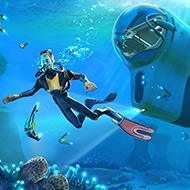
The escape ship in Subnautica does not exist anywhere at the start of a run — there is no wreck to find, no vessel to repair. You build it yourself out of raw ore, and until you’ve mined enough, you’re just a pixel diver swimming in open water with nothing to show for it.
| Genre | 2D pixel-art underwater survival |
| Platform | Browser and desktop |
| Core loop | Mine, gather, build the ship, escape |
| Session length | Short, single-sitting runs |
What Subnautica Promises Before You Even Load In
The name alone sets up expectations most players carry into any underwater survival game: a crash-landed vessel, a slow crawl through unfamiliar biomes, a scanner logging every creature and wreck fragment, and eventually a story about why the planet doesn’t want you leaving. That’s the genre template the name evokes, built over years by bigger, more ambitious underwater survival titles that turned exploration into the reward itself.
None of that framework is present here. There’s no scanner, no fragment-collecting, no narrative reveal waiting at the bottom of a trench. What you get instead is a compact, stripped-to-the-studs loop: swim, mine, carry your haul back, repeat until you’ve got enough to build.
That gap between expectation and reality is worth sitting with. A player expecting hours of biome-hopping will misjudge the pacing entirely, treating an early mining run like the opening act of a much longer story that never arrives.
The Scanner-and-Story Loop That Never Materializes
Bigger survival games in this genre build their middle hours around cataloguing the unknown — every creature, every wreck fragment, every biome transition unlocks a piece of a larger picture. Subnautica skips that structure entirely. There’s nothing to log and no slow-drip narrative rewarding patience.
What replaces it is a more direct kind of tension: you can see the whole shape of a run within the first couple of minutes. There’s water, there’s ore, and there’s a ship you haven’t built yet. Some players find that clarifying; others, expecting the genre’s usual slow-burn discovery arc, find it thin almost immediately.
It’s probably the single most divisive thing about the game once you look past the name. A short, focused mining loop isn’t automatically worse than a sprawling exploration game — it’s just a different kind of pressure, and whether it holds your attention depends entirely on what you came in wanting.
No Leviathans, No Biomes to Chart
Ask any longtime fan of the genre what they remember first and the answer is usually a specific creature encounter — something large and sudden emerging from deep water. Subnautica has none of that. There’s no leviathan-class threat patrolling open water, no moment teaching you to fear a specific depth.
The absence changes the emotional register of a run entirely. Instead of managing fear of the unknown, you’re managing a smaller, more mechanical pressure: did you gather enough ore, is your route back to the build site direct or wasteful. It reads closer to a chore-loop than a survival-horror one.
That’s not necessarily a loss. Removing the threat of a predator that size means the water in Subnautica feels calm rather than hostile, which rewards patient, methodical players over anyone chasing an adrenaline spike.
Hierro, Titanio, and a Two-Resource Mining Loop
Play for a few minutes and you’ll notice something that never gets explained: the resource labels read Hierro and Titanio rather than Iron and Titanium, a small inconsistency in an otherwise English interface that only someone who’s actually played would ever notice. It doesn’t affect anything mechanically, but it’s a fingerprint of how this was built.
The loop itself breaks down into a short, repeatable sequence:
- Locate a visible ore deposit in open water
- Hold the mine command until the material count ticks up
- Carry the haul back toward the build site
- Repeat until both the Hierro and Titanio totals clear the ship’s threshold
There’s no tool progression and no risk attached beyond the time it costs. Once you understand the ratio, the back half of a run becomes a logistics problem rather than a discovery one — efficient players start mapping which direction has denser clusters within the first minute or two.
Building the Escape Ship in Subnautica
The build itself is the payoff the loop is structured around, and it’s deliberately anticlimactic compared to what the genre usually offers. There’s no modular base-building here, no habitat expanded room by room over a dozen sessions. You reach a resource threshold, the ship becomes available, and leaving the planet is the run’s actual win condition.
- Players who treat the run as a speed challenge, optimizing the fastest route to enough ore
- Players who wander first and mine second, treating the small map as worth looking at
- Players replaying it purely to see if a cleaner Hierro-to-Titanio ratio shaves time off their last attempt
Once the ship exists, there’s nothing left to do but trigger the ending. That abruptness is what a lot of players remember afterward — not a dramatic escape sequence, just a sudden, quiet stop.
It’s easy to miss the significance of that moment on a first run, clicking through the ending screen before it registers that the whole loop is actually over.
The Short Run That Still Produces ‘One More Go’
A full clean run, once you know the mining routes, takes something like fifteen to twenty minutes — short enough that another attempt is a real, low-cost decision rather than a big commitment. That’s part of why a stripped-down build like this keeps a small audience coming back despite how little content there technically is.
The addictiveness comes from the same feeling any tight, low-friction loop produces: a slightly better route than last time, a sense the next attempt could shave off another minute even though the ship and the ocean look identical every time.
Subnautica isn’t hiding depth you haven’t found yet; what you see in the first run is close to everything there is.
What the Comment Section Actually Says About Subnautica
Most first-time reactions focus on how quickly the objective becomes clear — there’s barely a learning curve before the loop reveals itself, which is unusual for the genre and gets remarked on directly. Longer-term reactions split between players calling it a solid, addictive time-waster and players wishing there were more than two resources and one calm, threatless biome to mine through.
A recurring joke in player feedback is that the title alone does most of the heavy lifting, since nothing about the mining loop resembles the reputation the name carries. Neither reaction is wrong: a two-resource loop with no creatures and no story is thin against the genre’s biggest names, and also a genuinely hard loop to put down once the Hierro-to-Titanio math clicks.
Where the Real Underwater Survival Genre Still Shows Through
Even stripped down this far, a few genre fundamentals survive: reading the environment for where resources cluster, making trip-efficiency decisions instead of blindly wandering, working toward one tangible goal instead of an open-ended sandbox.
What makes Subnautica worth a session or two isn’t scope — it’s that the mining-and-build loop is genuinely well-paced for how small it is, right down to the moment the ship clears its threshold and the run ends on a Titanio count you spent the last five minutes chasing.
That’s a thinner slice of the underwater survival formula than most players associate with the name, but for a run this short, it’s not nothing.
- Is Subnautica the same as the well-known 3D survival game with the same name? No — this is a compact 2D build with a mining-and-escape loop, not the large-scale exploration game the name might suggest.
- How long does a full run of Subnautica actually take? Roughly fifteen to twenty minutes once you know efficient mining routes, closer to twenty-five or thirty on a first attempt.
- Are there any creatures or dangers to avoid? None that the mining loop confronts directly — the tension comes from resource logistics, not threats in the water.
Subnautica isn’t the sprawling survival epic its name promises, and it never pretends otherwise once you’re actually in the water. What it offers instead is a tight, honest loop built around Hierro, Titanio, and the quiet moment the escape ship finally clears its threshold.