






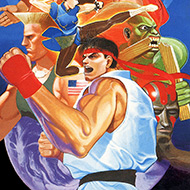
Street Fighter II
 (1 оценок, среднее: 5.00 из 5)
 Loading...
Similar Games







Description
Street Fighter II looks like it should feel dated decades later, and then someone lands a perfectly spaced Hadouken into a jumping opponent and it’s obvious why the format never actually went away.
| Genre | Fighting game |
| Platforms | Arcade, consoles, PC |
| Release Year | 1991 |
| Core Loop | One-on-one matches using special move inputs and spacing |
Ryu, Ken, and the Core Roster’s Special Moves
Street Fighter II built its identity around a roster with distinct special moves — Ryu and Ken’s Hadouken and Shoryuken, Guile’s charge-based Sonic Boom, Chun-Li’s rapid Lightning Kick — and learning input timing for these moves is still the first real wall new players hit. Beginners consistently struggle with charge-move characters like Guile before understanding that holding a direction, not just pressing it, is the actual requirement.
Spacing matters as much as the moves themselves; a Hadouken thrown at the wrong range just gives an opponent free time to close distance and punish.
Matchup Knowledge and the Meta Around Blanka
By the time players move past basic inputs, character matchup knowledge becomes the real skill test — a character like Blanka’s rolling attack behaves completely differently against a zoning character like Guile than against a rushdown character like Ken. Competitive players and casual players experience the same roster very differently, since matchup knowledge only really matters once both players know their special move inputs cold.
Community terminology around footsies and frame advantage largely traces back to games like this one, and longtime fighting game players still use Street Fighter II matchups as reference points in modern discussions.
What Still Gets Argued About the Original Balance
Character balance in the original release was famously uneven, with some versions of the game considered dominated by specific strategies, and even dedicated fans acknowledge this as a real flaw rather than defending it outright.
How do you perform Guile’s Sonic Boom consistently?
Sonic Boom requires holding back for roughly a second before pressing forward and punch, and the charge-based timing is what trips up most beginners compared to the quarter-circle inputs used by characters like Ryu.
Which character is easiest for beginners to learn?
Ryu is generally considered the most beginner-friendly, since his Hadouken and Shoryuken use straightforward quarter-circle and inputs rather than the charge-based timing that trips up newcomers on characters like Guile.
Street Fighter II’s special move inputs and character matchups laid out a template the entire genre still follows, and a well-timed Shoryuken against a jumping opponent still lands with the same satisfaction it did in arcades decades ago.