















Roc’n Rope
 (1 оценок, среднее: 5.00 из 5)
 Loading...
Similar Games











Description
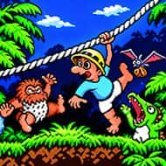
Roc’n Rope looks like a simple climber built around a single harpoon, but it plays like a game about committing to every shot before you know where the line will land. Each screen asks you to reach the top with nothing but a rope, patience, and a clear read on where the dinosaurs will be two seconds from now.
Harpoon Climbing in Roc’n Rope
The core move is simple: fire the harpoon upward, let it catch a ledge, and haul yourself up the line. Everything else in the game grows out of that one action. Players familiar with the arcade original know that the hero’s movement revolves around the rope rather than a jump, so progress is about planning the next anchor instead of reacting mid-air.
Beginners tend to fire the rope the moment they see a ledge, then discover that a line fired too early catches nothing or leaves them hanging into a patrolling dinosaur. Waiting a beat, lining up under the platform you actually want, and then firing is the habit that separates a clean climb from a death on the first screen.
That patience is the whole lesson of the first world.
Why Roc’n Rope Still Matters to Wire Action Fans
Players call this style wire action, and Roc’n Rope is often cited as the game that started it. Fans of Bionic Commando will recognize the logic immediately: the rope is not a trick but the way you move, and that idea was later expanded into a much bigger action game.
This conversion is an unofficial take on the arcade original for the Commodore 64, with four worlds that make full use of the system’s colors. Anyone who remembers the arcade will find a faithful structure: fixed single screens with no horizontal scrolling, and layouts that loop once you have cleared them.
That faithfulness cuts both ways. Retro arcade fans who want a pure loop will be happy, while players used to checkpoints and modern difficulty curves may find the arcade-era strictness hard to love. Nothing here pretends to be gentler than a cabinet from the early eighties.
Worlds, Dinosaurs, and the Golden Roc
The goal is to climb through each world, from cliffs to ice caves, in pursuit of the golden Roc bird, whose missing tail feathers you are trying to return. Early in the game the screens teach rope timing, but by the time you reach the ice caves, ledges demand tighter planning and the dinosaurs leave less room for a sloppy line.
Power-ups grant a short window of invincibility and the ability to attack directly, and the smart play is to spend that window on the crowded stretches rather than on an easy climb. Once one appears, it pays to look ahead and decide where it will do the most good before it runs out.
Players on Android get the same single-screen structure in a pocket-sized form, which suits the short, repeatable attempts the game is built around.
Making Every Rope Count in Roc’n Rope
Efficient climbing comes down to a few habits that experienced players repeat on every screen.
- Line up under the exact ledge you want before firing the harpoon.
- Let a dinosaur pass instead of racing it across a platform.
- Save power-ups for the busiest sections rather than the easiest ones.
Because screens loop once conquered, the best players treat a second pass as a chance to tighten their route rather than a repeat. Score-chasers will find the real depth there, since the same layout rewards a faster, cleaner path every time through.
Every retry also teaches you the dinosaurs’ timing, and a few attempts on the same screen usually reveal a safe rhythm. That slow build from guessing to knowing is what keeps the climb compelling.
Roc’n Rope rewards anyone who can wait for the right ledge, trust the harpoon, and keep chasing the Roc through four worlds of cliffs and ice caves. Once the rope catches and the climb clicks, the dinosaurs stop feeling like obstacles and start feeling like timing puzzles you are about to solve.