










Dinosaur Game
 (1 оценок, среднее: 5.00 из 5)
 Loading...
Similar Games



Description
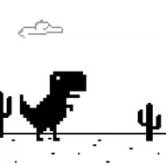
Dinosaur Game looks like a dead end slapped onto a no-internet error screen, but it plays like a genuine test of reflexes that never actually eases up. There’s no ending waiting for you, no final boss, no map to explore — just a T-Rex, a stretch of desert, and a score that keeps climbing until you make a single mistake.
| Genre | Endless runner |
| Players | Single player |
| Session Length | As long as you can survive |
| Structure | Continuous, difficulty rises with score |
Jumping and Ducking Past Cacti and Pterodactyls
The core of the game is deceptively small: jump over cacti, duck under pterodactyls, and don’t mistime either. Cacti come in clusters of varying width, so a jump timed perfectly for a single cactus can still clip the edge of a wider cluster if you launch a fraction too early or hold the jump a beat too long.
- Cacti — ground-level obstacles that demand a well-timed jump, often bunched in twos or threes
- Pterodactyls — airborne obstacles that fly at different heights, sometimes requiring a duck instead of a jump
Reflex players tend to lean on jumping alone and struggle once pterodactyls start appearing at head height, where a jump sends the T-Rex straight into them instead of clearing them. Learning to read a pterodactyl’s altitude in the split second before it reaches you is one of the clearest skill checks the game offers.
Early runs are almost entirely about cacti, and it’s easy to develop a rhythm that falls apart the moment a pterodactyl breaks the pattern.
Why Dinosaur Game Never Slows Down
Speed increases steadily and permanently as your score climbs, and there’s no mechanism to reset that pace short of dying. That constant acceleration is the entire difficulty curve — the obstacles themselves don’t get more complex, they just arrive faster than your reaction time can comfortably keep up with.
Patient players who’ve played dozens of runs describe a point where jumps stop being conscious decisions and start happening on pure muscle memory, which is usually when the highest scores start showing up. Community discussion around the game often calls this stretch “the blur,” the point where individual obstacles stop registering as separate decisions.
Casual players who only play during actual internet outages rarely reach this point, since a restored connection usually ends the run before the speed becomes a real problem.
The Day-Night Shift That Changes How You See Obstacles
Once your score crosses 500 points, pterodactyls start showing up more frequently, and shortly after that the screen itself flips from a light background to a stark black one. The inverted colors force your eyes to readjust mid-run at exactly the moment the game is already asking more of your reflexes.
Players who don’t expect the shift the first time tend to lose a run right as the screen flips, simply from the momentary disorientation. It’s one of those details you only really notice once you’ve lived through it — the half-second where the desert goes dark and every obstacle briefly looks unfamiliar again.
Once you’ve adjusted to it a few times, the flip stops being a threat and becomes a useful checkpoint for judging how far into a run you actually are without glancing at the score.
Chasing a Higher Score One Run at a Time
There’s no upgrade system and no unlockable content — the entire replay loop is chasing a slightly better score than your last attempt. That simplicity is exactly why the game holds up as a quick distraction rather than something you sit down to master over hours, even though plenty of players end up doing exactly that anyway.
- Start the run and get comfortable with the base jump timing before the speed ramps up.
- Watch for pterodactyl height changes rather than reacting to their shape alone.
- Expect the day-night flip once your score passes into the hundreds, and don’t let it break your rhythm.
- Treat any run that survives the first speed increase as a genuine attempt worth focusing on.
Completionists chasing a personal best usually restart immediately after a death rather than reviewing the run, since there’s genuinely nothing to review beyond the number on screen. Speedrunners of a different sort exist too — players who intentionally crash early just to see how quickly they can trigger a new run, treating the restart itself as the game.
What Makes Dinosaur Game Impossible to Truly Finish
Because the speed increase never caps in any way most players have documented, there’s no such thing as a clean, final victory — only a longer streak than before. That’s a divisive point for some, since a game with no true end can feel pointless to players who want a defined finish line to work toward.
For most who keep coming back to it, though, that absence of an ending is precisely the appeal. Dinosaur Game isn’t trying to be finished, only outrun for a little longer each time, and the lack of any reward beyond the number itself is what keeps the loop feeling honest rather than grindy.
By the time a pterodactyl clips you at a speed the early cacti never hinted at, the game has already made its point: the desert was never going to end on its own.
How far do you need to run before the screen changes to night?
The shift happens once your score climbs past roughly 500 to 600 points, around the same stretch where pterodactyls start appearing more often alongside the cacti.
Can you duck under every obstacle instead of jumping?
No — cacti sit on the ground and require a jump, while only low-flying pterodactyls can be ducked under. Misjudging which obstacle is which at high speed is one of the more common ways a run ends.
Does Dinosaur Game ever stop getting harder?
Not in any way most players have found. The speed keeps climbing the longer a run lasts, which is why the game has no real finish line, only a personal best to beat.
Whether you’re ducking under a low pterodactyl or watching the desert flip to black for the first time, Dinosaur Game keeps the T-Rex running toward a finish line that was never actually there.