










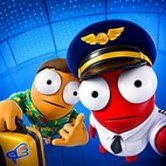
Dear Passengers
 (1 оценок, среднее: 5.00 из 5)
 Loading...
Similar Games




Description
What happens when the cargo bay you forgot to lock turns out to be holding something that bites? That’s the kind of question Dear Passengers is built to ask, usually at the worst possible altitude. One player takes the cockpit and fights dynamic weather and turbulence, while the rest of the crew works the cabin — serving passengers, patching the plane, and trying to remember which crate was the illegal one.
| Genre | Physics-based co-op adventure |
| Mode | Online co-op |
| Perspective | First-person |
| Setting | A single failing aircraft, mid-flight |
Running an Airline That Should Have Been Grounded
The premise of Dear Passengers is almost insultingly simple: you work for the worst airline in the sky, and passenger safety sits somewhere below remembering to lock the cargo bay. Before takeoff, the crew chooses which passengers and which cargo manifests to accept, and riskier manifests pay better — which is how a crate of something that definitely isn’t luggage ends up in the hold.
That choice at the gate shapes the entire flight. A manifest padded with contraband might fund the run, but it also guarantees a mid-air complication nobody planned for.
None of this is optional once the plane leaves the ground.
Cockpit Duty Versus Cabin Chaos
Flying isn’t a passive job in Dear Passengers. Weather and air pockets shove the plane around in real time, and the pilot has to fight the controls while everyone else scrambles below. Physics runs through everything — the plane pitches and rolls under your feet while you’re carrying a meal tray or trying to weld a hole shut, so a simple task turns into a balance challenge without warning.
The cabin crew’s job list grows fast: serving meals, calming passengers, hauling loose cargo, and patching whatever the plane decides to break next. None of these tasks happen in isolation, since a passenger complaint and a cargo spill tend to hit at the same moment.
How does cargo affect a flight in Dear Passengers?
Riskier cargo manifests pay more at the gate but introduce complications mid-flight — anything from a shifting crate to livestock that shouldn’t have been loaded in the first place.
Passengers Who Escalate at the Worst Time
Passenger interactions in the game don’t stay small. A single complaint can spiral while the crew is already mid-repair, forcing someone to abandon a half-finished fix to go smooth things over in the cabin. Community discussion around Dear Passengers keeps circling back to this — the game rewards communication over speed, because reacting alone almost always means falling behind on two problems instead of one.
Solo play isn’t the point here.
Everything about the crew structure assumes a plane full of people making increasingly bad decisions together, not one person managing a checklist.
The Plane Fights Back
Systems degrade as the flight goes on, so a manageable early leg can turn into a scramble by the time you’re circling for landing. Turbulence that felt minor on takeoff gets worse the longer a problem goes unpatched, which means ignoring a small leak early tends to guarantee a bigger one later.
This is where the game earns its comparisons to other chaotic co-op titles — the difficulty curve isn’t scripted, it’s the accumulation of every shortcut the crew took earlier in the flight.
What Makes Dear Passengers Different From Other Co-op Games
Most co-op games ask players to cooperate toward a clean win. Dear Passengers asks players to cooperate while losing with some dignity intact. There’s no mention of a solo mode, which suggests the whole design leans on two or more people making worse decisions together rather than one person managing everything alone.
- What’s the best way to handle a cargo emergency mid-flight? Stabilize the crate or container first, since an unsecured load worsens the plane’s physics problems faster than almost anything else on the checklist.
- Can one person play cockpit and cabin at the same time? Nothing in Dear Passengers is built around solo play — the cockpit and cabin roles are designed to pull attention in opposite directions.
- Does accepting riskier cargo always pay off? It pays more at the gate, but the game treats that payout as a trade against a higher chance of complications once you’re airborne.
Dear Passengers turns a checklist into a group crisis, and the plane never lets the crew forget it. Whatever’s rattling around in the cargo bay by the time you’re on final approach is usually the same crate nobody wanted to check twice.