















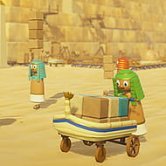
How They Built the Pyramids
 (1 оценок, среднее: 5.00 из 5)
 Loading...
Similar Games








Description
You scoop wet Nile clay into a mould, press out your fourth brick of the morning and look up at a pyramid that is still mostly sand. How They Built the Pyramids has just told you the target is 23,426 blocks, and your friends are already arguing about whose idea it was to start.
| Genre | Casual simulation with building and automation |
| Players | 1 to 8 in co-op, or solo |
| Goal | Place 23,426 blocks |
| Pyramid size | 26 layers, 65 metres tall |
| Helpers | Shabti workers |
Mud, Bricks and a 65-Metre Goal in How They Built the Pyramids
The premise is a joke with a serious number behind it. There are plenty of theories about how the pyramids went up, and this game lets you and up to seven friends test your own. Everything starts with clay from the Nile and ends with a 26-layer pyramid rising 65 metres. Between those two points sits a lot of carrying, and the carrying is the point.
The first hour is about learning how your hands work. You make bricks, improve their quality and find faster ways to produce them. It is small and a little repetitive by design, which is fair to say upfront, because the fun only grows once the operation has something to scale.
Players who like cosy resource loops will settle in quickly. Those who want constant action may find the opening quiet, and that is the first thing worth knowing before you commit an evening.
From Nile Clay to the Top Layer
Every brick follows the same journey, and understanding it early saves a lot of confusion. The loop below is the backbone of the whole game:
- Dig Nile clay and turn it into raw bricks.
- Improve brick quality and speed up production.
- Carry, toss or transport the bricks toward the pyramid.
- Place each block on the current layer until it is complete.
Beginners usually bottleneck at step three. Bricks pile up at the production end while the pyramid waits, so the real puzzle is logistics rather than making more clay blocks. A crew that talks about who carries and who builds finishes layers much faster than one where everyone grabs whatever is nearest.
By the time the first layers are stacked, you will notice how much distance matters. The higher the pyramid grows, the further every brick has to travel, which is exactly why players start inventing shortcuts.
Shabti Helpers and the Cost of Keeping Them Happy
Doing everything by hand does not scale, so the game gives you Shabti, little workers you can hire to take over the dull jobs. They are the first step from a hands-on crew to a small organisation. A group that assigns Shabti to repetitive work can spend its own time on the tricky parts of the build.
The catch is stated clearly: keep them happy. Helpers are not a one-time purchase, and neglecting them has a cost. Exactly how that plays out is something each crew will discover in its own way, and it adds a light management layer on top of the building.
A planner in your group will love this part, because it rewards spreadsheets in the head. Everyone else can simply watch the workers hurry about, which is a gentle comedy of its own.
Automation Chains: When Hand Carrying Stops Scaling
Once the Shabti arrive, the game shifts toward production lines. You build, connect and automate until bricks flow without anyone touching them. The aim is to let machines handle the heavy lifting while you concentrate on finishing the pyramid, and the satisfaction comes from watching a messy operation turn orderly.
Efficiency is more than raw speed. A long chain breaks if one link is slow, so experienced players look for the weakest stage rather than adding more of the strongest one. That habit carries across the whole game and is worth learning before the pyramid gets tall.
Your abilities also grow, letting you carry more as the operation expands. It is a gentle progression curve, and the honest question is whether it arrives soon enough to keep the repetitive early stretch bearable.
Chaos in Co-op: Tossing Bricks and Launching Friends
This is where the game stops being a tidy factory sim. You can toss bricks to teammates, send them flying across the site and even launch your friends over the pyramid. The store description itself says there are easier ways to build, but asks where the fun is in that.
A tossed brick that lands short and a teammate who forgets the warning about standing underneath are the moments every crew remembers. Comedy players will chase these on purpose, while efficiency players will quietly turn the same tricks into faster delivery. Both approaches are valid and often clash in the same lobby.
Solo players get a calmer version of the same puzzle. You lose the chaos and the shouting, but you gain total control over the production line, which suits anyone who prefers planning to improvising.
Questions Before You Start Building
- How many players can join a pyramid crew? The game supports 1 to 8 players in co-op, and it can also be played solo. Larger crews can divide brick making, carrying and placing, while a solo builder leans on Shabti and automation to cover the same jobs.
- How many blocks does the pyramid need? The pyramid takes 23,426 blocks across 26 layers and stands 65 metres tall. After you finish it, you can keep building monuments and earn blessings, so the work does not stop at the capstone.
- Can you play by yourself? Yes, single-player is supported, and you can hire Shabti to fill the gaps a crew would normally cover. Expect the early brick making to feel slower alone, which is why many players start with friends and later try a solo run.
How They Built the Pyramids turns a historical mystery into a loud, shared logistics problem, and the best sessions come from crews who stay with it past the first dozen bricks. Keep the Shabti happy, watch the weak link in your production line and let a friend launch you across the pyramid at least once.