










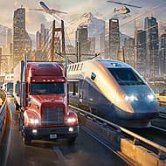
Transport Fever 3
 (1 оценок, среднее: 5.00 из 5)
 Loading...
Similar Games








Description
What happens to a transport empire when one overloaded station starts choking three separate lines at once? Transport Fever 3 turns that question into the daily rhythm of play, asking you to lay rail, road, sea lanes, and air routes across a procedurally generated map while every vehicle quietly adds to your costs. It rewards patience, careful planning, and a willingness to rebuild what you built an hour ago.
Tycoon Mode Economics in Transport Fever 3
The core loop is honest. Every delivery earns money, and every train, truck, plane, or ship raises your running costs. Early in the game you are managing a few horse-drawn wagons and a single road, so a bad route costs little, but by the time you own a mixed fleet, the maintenance bill becomes the number you check first. Reputation, noise, and pollution sit beside income as the other pressures that decide what a town will tolerate.
A loan and contract system adds risk versus reward. Contracts hand you objectives with a clock attached, and the difficulty options let you decide how forgiving the economy should be, from a punishing race to a relaxed build.
Beginners commonly expand too fast, buying vehicles before a route has proven itself. Short, cheap, profitable lines first and loans second is the pattern most veterans recommend. Reception at launch has been mixed, with roughly two-thirds of reviews positive, and the split tends to fall between players who love the tycoon depth and those who wanted a smoother first hour.
Building Rail, Road, Sea, and Air Routes That Actually Pay
The construction tools cover everything from country roads to highways with ramps, from old wooden rails to modern high-speed track, plus overland trams with their own lanes and configurable lane connections. The tools are flexible enough that two players will solve the same map with completely different networks. A first profitable line usually follows this order:
- Pick an industry that has a nearby town or second industry demanding its output.
- Lay the shortest road or track that keeps gradients gentle.
- Place a station beside the producer and another at the destination.
- Assign one or two vehicles and watch the loading before adding more.
When a network starts to struggle, the data layers are the fastest diagnosis. They highlight traffic hotspots, delivery problems, and excessive noise or pollution, so you can find the real bottleneck instead of guessing.
The traffic simulation includes lane control and realistic behavior such as overtaking. There is a quiet satisfaction in watching a truck pass a slow bus on a road you shaped yourself, and road-network fans will happily spend an evening perfecting one junction.
Cargo Chains, Warehouses, and Living Towns
More than 35 industries feed the economy, including off-shore sectors such as fishing grounds and oil platforms. Industries expand based on demand, and their production can be boosted by workers and optional inputs, so a well-supplied factory grows into a serious customer.
The redesigned cargo simulation gives you full control over loading and unloading, which matters once lines start competing for the same goods. Warehouses and specialized terminals allow intermediate storage, and using them is one of the techniques many players miss until a chain keeps backing up.
Towns are living systems. Every citizen has a home, a job, and places to go, and dynamic districts grow out of those simulated inhabitants. Specializing your deliveries pushes a settlement toward a commercial center, an industrial powerhouse, or a commuter city, which suits city builder fans who enjoy shaping growth as much as profit.
Eras and Climate Zones: From Horse-Drawn Wagons to Concorde
The game spans more than 125 years of transport evolution and over 275 vehicles. Steam trains and jets can run side by side as you move through the 20th century, and buildings, people, and cars follow design trends through time, so the world visibly ages around your network.
Four climate zones change how you plan: temperate valleys, desert plains, tropical islands, and a new subarctic region with its swamps. Each zone demands a fresh approach to terrain and cost, and a route strategy that works in a valley can fall apart across islands.
Dynamic weather and a full day-night cycle give the map a mood of its own, and successful companies earn the right to build world-famous landmarks as proof of their achievements. It is a slow burn rather than an instant payoff, and some players find the early eras too gentle before the pressure builds.
Campaign, Sandbox, and Map Editor: Choosing Your Pace in Transport Fever 3
The story campaign offers missions inspired by real historic events, testing planning and efficiency with a clear goal. It suits players who want structure rather than an empty map.
Sandbox mode and the map editor serve the opposite crowd. You can disable the economy entirely and build the most stunning city, station, or diorama you can imagine, or craft maps close to reality with the in-game editor. Diorama builders often never touch a loan at all.
The Deluxe Edition adds extra flavor for players who want more variety:
- Concorde, London Bus, Trans-Europe Express, Peterbilt 359, Hong Kong Tram, and Sikorsky S-76 Spirit
- Eiffel Tower and Taj Mahal as landmarks
- Redrock Bends, Northern Gates, and Emerald Shores as handcrafted maps
Questions About Transport Fever 3 Before You Lay Your First Track
- Is Transport Fever 3 good for beginners? Yes, because the difficulty options let you soften the economy while you learn stations, lines, and cargo. The campaign missions also give you specific goals, which makes the first hours less overwhelming than an open tycoon map.
- Can I play Transport Fever 3 without the economy? You can disable the economy entirely and treat the sandbox as a canvas. Combined with the level editor, that lets you focus on landscaping, station design, and cities without worrying about maintenance or loans.
- Does Transport Fever 3 support mods? It does, with improved modding tools for vehicles, buildings, and infrastructure. An in-game mod browser makes it easy to discover and share creations across platforms, and the map editor adds another layer of customization.
Transport Fever 3 works best when you treat every line as a small business that has to earn its place. Balance your warehouses and terminals, learn what each climate zone demands, and the network you build stops feeling like a puzzle and starts feeling like a company with a history.