










The Girl in the Window
 (1 оценок, среднее: 5.00 из 5)
 Loading...
Similar Games







Description
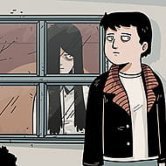
You push on a door that hasn’t opened in twenty years, and somewhere above you, a curtain moves. That’s how The Girl in the Window starts: no tutorial voice, no safety net, just Dan standing in a house Hidden Town has avoided for two decades and a silhouette watching from an upstairs window that shouldn’t have anyone behind it.
| Genre | Point-and-click escape, horror mystery |
| Setting | Hidden Town, an abandoned house |
| Playable Character | Dan |
| Format | Single-player, room-based puzzles |
The premise is simple to state and uncomfortable to sit inside: a house where a family died, sealed for twenty years, and a girl who keeps appearing at its window even though nobody’s supposed to be in there. You’re not investigating from the outside. You’re locked in, which means every puzzle you solve is also a step toward finding out what actually happened to her.
Dan’s First Steps Inside The Girl in the Window
The opening rooms do a lot of quiet work. You’re given free rein to click around a cluttered parlor, and the game trusts you to notice what’s out of place rather than highlighting it for you. A drawer that won’t open, a photograph turned face-down, a smell of something burnt that has no obvious source — these are the game’s real tutorial, teaching you to treat every surface as a potential clue rather than set dressing.
Players coming from more forgiving escape-room titles sometimes rush the first room and miss items that only become obvious once you’ve read a diary page two rooms later. That’s a deliberate rhythm: the house rewards backtracking, and Dan’s inventory fills up with objects whose purpose isn’t explained until much later.
What trips up newcomers most is treating locks as purely mechanical. Several codes in the house are tied to the story rather than to a number you find nearby — you have to connect a date on a newspaper clipping to a birthday mentioned in a letter, for instance. Skimming the text kills your momentum faster than any jump scare does.
Reading the Randomized Locks and Codes
One detail that surprises returning players is that the codes themselves change between playthroughs. The safe combination that was 1746 on your first run might be something else entirely the second time. What stays fixed is the logic: the same clue location always points to the same type of answer, just with different digits or symbols attached.
- Symbol locks tied to objects found earlier in the same room
- Numeric codes hidden inside dates, page numbers, or measurements
- Combination drawers that only open after a specific item is placed nearby
This randomization is part of why speedrunning The Girl in the Window from memory doesn’t work the way it does with fixed-puzzle escape games — you can remember the method, but you still have to hunt for this run’s numbers. Community discussion around the game leans heavily on this point, since guides have to describe the logic rather than list a single universal code.
Mia, the Portrait, and What Divides the Community on The Girl in the Window
Dan isn’t alone in the wider story. Mia, introduced properly later in the Hidden Town series, is referenced throughout the house through photographs and notes that hint at a connection neither character fully understands yet. Finding her name attached to an object in a room you thought you’d already cleared is one of those small, specific jolts that only registers if you’ve been paying attention to names, not just puzzles.
One moment almost everyone who finishes the game mentions is a portrait near the stairwell whose expression seems to shift slightly if you glance at it, look away, and look back. It’s a small, cheap-sounding trick on paper. In practice, on a first playthrough, it’s the point where a lot of players stop clicking casually and start checking corners before they walk into a room.
Not everything lands for everyone. A built-in hint system means you’re rarely stuck for long, and some horror purists find that this softens the dread the house is trying to build — if a stuck puzzle is never more than a tap away from a nudge, the isolation of being locked in an abandoned house loses a little of its bite. It’s a fair trade-off for players who want to actually finish the story, less so for anyone chasing pure escape-room tension.
A typical first clear runs one to two hours; achievement hunters and anyone chasing every diary page, photograph, and hidden note should plan closer to three or four. Casual point-and-click fans tend to stop there, while completionists keep replaying to see how the randomized codes reshuffle the puzzles they thought they’d mastered.
How Many Endings Does The Girl in the Window Have?
The house doesn’t resolve the same way for every player, and finishing it once won’t show you everything Hidden Town is hiding. Multiple outcomes exist depending on choices and details you notice along the way, which is part of why the game supports more than a single playthrough.
Do the Puzzle Codes Change Every Playthrough?
Yes. The numbers, symbols, and combinations reset each time you start over, though the clue that tells you where to find them stays in the same spot. A code that was pulled from a newspaper date on one run might come from a different document entirely on the next.
Whatever the house’s exact ending count turns out to be for you, The Girl in the Window is built to be walked through more than once, and the portrait by the stairwell is proof the game knows exactly when to make you flinch.