







Wanderburg
 (1 оценок, среднее: 5.00 из 5)
 Loading...
Similar Games







Description
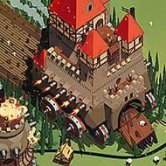
Wanderburg looks like a joke about castles that learned to drive, but it plays like a fast bullet heaven that keeps demanding build decisions. You pilot a Castle on Wheels through a medieval world where villages run, smaller fortresses get in the way, and the only way to stay alive is to grow bigger than everything chasing you.
| Genre | Action roguelike with bullet heaven elements |
| Platform | Windows PC |
| Controls | Mouse, keyboard, or controller |
| Players | Single-player |
| Status | Early Access |
Rolling a Castle on Wheels Through Wanderburg
You steer your Castle on Wheels from a top-down isometric view, and the whole action rests on movement. Where the castle rolls decides what it swallows, what it dodges, and how quickly the next stronghold drifts into range. Players coming from other survivor-style roguelikes will recognize the rhythm within minutes, though the driving gives it a heavier, more physical feel than a character on foot.
The premise flips the usual siege story. Castles hunt and villages flee, so you are not defending a wall, you are the wall, and you are hungry. That inversion is the reason the game stands out in a crowded genre, and it is easy to grasp even if you have never touched a bullet heaven before.
Movement is the main verb.
Everything else, from the machinery bolted to your walls to the enemy castles you chase, hangs off that one skill. Controller support means the driving translates well to a couch, and the option to use mouse and keyboard keeps it comfortable at a desk.
What Gets Devoured: Villages, Flocks, and Rival Fortresses
Growth is the answer to the question most beginners ask first: how do you actually grow your castle in Wanderburg? Fleeing villages, wandering flocks, and smaller fortresses all feed your expansion, and defeating powerful enemy castles pushes your evolution further. The castle does not simply gain numbers, it gets physically bigger.
- Roll into range of a fleeing village or a wandering flock and consume it.
- Watch your Castle on Wheels expand with every meal.
- Take on smaller fortresses once your size lets you win the fight.
- Crush a powerful enemy castle to push your evolution further.
A sensible habit in the first minutes is to treat growth as the priority, since a bigger fortress is what lets you take on rival castles later. Reviewers keep describing the one more run pull, and this loop is where it comes from: every target you devour makes the next one easier and more tempting.
Players who love snowball fantasies will find the appeal obvious, because the power curve feels earned by driving rather than by waiting on a timer.
Modules and the Art of Breaking Wanderburg
The modular arsenal is where the game invites you to misbehave. You assemble your castle piece by piece, and the store text openly encourages you to break the game with unusual combinations. Between runs you unlock new modules that open up fresh strategies, so the toolbox keeps widening the longer you play.
- Cannons mounted along the castle walls
- Arcane towers staffed by wizards
- Explosives you deploy against crowds
- Steam-powered siege engines that roll beside arcane artillery
Theorycrafters who enjoy hunting for a broken combination are the players this system was made for. The point is not to find one correct loadout but to notice which pieces reinforce each other and lean into them, the way a bullet heaven build snowballs when everything lines up.
Not every pairing is equally strong, and that is part of the conversation. The team says it watches Discord and the Steam forums for bug reports and balance rants alike, which tells you where the community argues the most: which modules are too good, and which are decoration.
Vehicles, Artifacts, and Captains Between Runs
Between runs, unlockable vehicles, artifacts, and captains widen your options and add variety to each attempt. This is the classic roguelite promise, and the game leans into it: even a failed run pushes something forward. The achievement list even includes a Spiderburg unlock, which hints that the castles can get stranger than a fortress on wheels.
The 26 Steam achievements give the long-term goals a shape. Two of them track distance, with one at 100,000 meters travelled and another at 1,000,000 meters, which shows how much of the game is simply driving a big machine across the map. Completionists will find those milestones a natural reason to keep queueing another run.
Roguelite fans who care most about permanent unlocks should note that this is the layer where the variety comes from. Modules change how a run plays, while vehicles and captains change how it starts, so mixing them is how you avoid seeing the same castle twice.
Difficulty Levels and the Dark Forest Push
Runs roll through different biomes across multiple difficulty levels, and the achievement named Welcome to the Dark Forest suggests the Dark Forest is one of the milestones players chase. Once you reach it, your build has to hold up against tougher enemy castles, which is where a loose pile of modules stops being enough.
As in most bullet heaven games, pressure builds gradually and then all at once. A coherent build with towers, cannons, and siege machinery that support each other survives much longer than a random collection, and that is the difference players talk about when they compare early runs with late ones.
If you are wondering about hardware or comfort, the game plays with mouse, keyboard, or controller, and switching between them does not change the core loop. That flexibility helps when a long session leaves your hands tired.
Early Access Friction in Wanderburg
Now the honest part. The game is in Early Access, and the team expects that stage to last around 6 to 12 months, with more content and polish still to come. About 82 percent of the 991 English reviews on Steam are positive, which is strong, but the content ceiling is real, and players who want a finished campaign may prefer to wait.
The other debate is balance. Fans love that the game lets them break it, while purists worry that the strongest builds flatten the challenge. Both camps agree the systems are fun, and both are the reason the developers say they want to hear every wild idea from the community.
Players who enjoy watching a game grow with feedback will feel at home, since each update reshapes which builds feel best.
Wanderburg is easiest to recommend to anyone who wants a build-driven roguelike that treats a Castle on Wheels like a living machine. Swallow enough villages, stack your arcane towers and cannons, push toward the Dark Forest, and see how far your fortress can roll before something bigger arrives.