









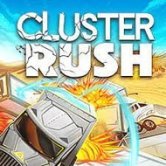
Cluster Rush
 (1 оценок, среднее: 5.00 из 5)
 Loading...
Similar Games









Description
In Cluster Rush you start on a single moving trailer with nothing but the truck fleet ahead of you and a camera that refuses to slow down, which matters because every choice from that first second onward has to be made while still in motion. There’s no pause to study the road, no safe stretch to catch your breath — just trailer after trailer rolling, tilting, and occasionally exploding beneath your feet.
| Genre | 3D endless runner |
| Objective | Cross the moving truck fleet without falling or crashing |
| Controls | Up/W to jump, A/D to lean and shift |
| Camera | Fixed forward push, no backtracking |
| Best for | Players who like reflex-heavy, short-burst runs |
Reading the Truck Fleet Before You Jump
The trucks in Cluster Rush aren’t a static bridge — they drift, flip onto their sides, slam into each other, and sometimes detonate outright, which means the trailer you’re aiming for might not be flat by the time you land on it. Good runs come from watching two or three trailers ahead rather than the one directly under your character, since a truck that looks stable right now can tip before your jump lands.
The lean controls do more work than most new players expect. Tapping left or right doesn’t turn your character around — it shifts your position on the current trailer just enough to dodge a side-mounted barrier or line up a narrower gap between vehicles. Ignoring this and relying only on the jump key is the single biggest reason casual runs end early.
Cluster Rush rewards momentum over caution. Players in the game’s community often describe the ideal run as “reading the pile-up,” meaning you commit to a jump based on where a trailer will be in half a second, not where it is right now.
Why the Forward Camera Changes Everything
Unlike a standard obstacle course where you can retreat and reset your angle, Cluster Rush’s camera keeps pushing you toward the next hazard whether you’re ready or not. Early in a run this feels forgiving — the fleet is loosely packed and gaps are generous. By the time speed ramps up several trailers in, that same forward pressure turns every hesitation into a fall.
This is where the game splits its player base. Some treat Cluster Rush as a pure reflex test, mashing through runs to build muscle memory for the fleet’s common patterns. Others slow their own inputs deliberately, accepting a lower top speed in exchange for cleaner landings, since a fall usually ends the run outright rather than costing a life or checkpoint.
What Beginners Consistently Miss
The most common early mistake is jumping the instant a trailer comes into view instead of waiting for it to settle. A trailer mid-flip or mid-crash looks like a landing spot but often isn’t one yet — timing the jump a beat later, once the truck’s motion stabilizes, is a technique that separates short runs from long ones. New players also tend to ignore the lean keys entirely, treating Cluster Rush like a pure jumping game, which leaves them stranded when a barrier appears on the side of a trailer rather than dead ahead.
One honest complaint that comes up often in discussions of Cluster Rush is that a fair number of falls feel like the truck fleet’s physics turned against you rather than any real misjudgment on your part — a trailer clipping unexpectedly, or a barrier appearing with almost no warning at higher speeds. It’s a fair criticism of a game built around unpredictable collisions, and it’s part of why players tend to treat their own high scores as personal bests rather than a skill ceiling.
What does keep a run alive longer than most is staying slightly behind the fleet’s leading edge instead of chasing the fastest trailer available — a habit that answers the question players most often ask about surviving Cluster Rush’s later stretches, where trucks stack up close enough that a single bad lean can end the run on contact.
Cluster Rush stays tense because the truck fleet never gives you a clean, predictable path for long, and every trailer you clear cleanly in the middle of a chaotic run feels earned rather than lucky.