










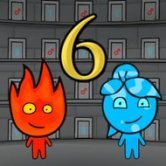
Fireboy and Watergirl 6: Fairy Tales
 (1 оценок, среднее: 5.00 из 5)
 Loading...
Similar Games










Description
What happens when Fireboy walks into a puddle three seconds after Watergirl solved the switch that put it there? He’s dead, the level resets, and you’re back at the last checkpoint wondering which of you actually made the mistake. That’s the rhythm of Fireboy and Watergirl 6: Fairy Tales — cooperation with a punishment clause.
| Genre | Cooperative puzzle-platformer |
| Players | 1 (dual control) or 2 |
| Setting | Fairy tale themed levels |
| Win Condition | Both characters reach the exit door |
Fireboy and Watergirl 6: Fairy Tales and the Two-Character Split
The core rule never changes across the series, and this entry doesn’t break it: Fireboy dies in water, Watergirl dies in fire, and both of them die in the acid pools that show up in the later levels. Everything you do has to respect that split, which is what turns a simple maze into an actual puzzle the moment a lever is only reachable by the character who can’t survive the path to it.
Playing solo means controlling both characters with separate key sets, arrow keys for one and WASD for the other, and that split attention is genuinely the hardest part for new players — harder than any individual obstacle. Two-player sessions remove that problem but introduce a different one: coordinating who moves first through a timed gate.
The game leans into this tension by building levels where the “wrong” character reaching a switch first actually blocks the other from progressing, not just delays them.
Cinderella’s Carriage and the Timing Trap
The Cinderella-themed level is one of the clearer examples of how the fairy tale skin isn’t just decoration. A carriage rolls across the path on a loop, and Watergirl has to time a dash past it while Fireboy handles a separate flame hazard on his own side of the split path.
Miss the carriage’s timing once and you don’t just lose Watergirl — you often lose the run entirely, because the level doesn’t let you continue with only one character alive. That single mechanic teaches a lesson the rest of the game keeps testing: read the loop before you commit to crossing it.
Players who try to muscle through by guessing tend to burn far more attempts here than on levels that come later but are technically more complex.
Sleeping Beauty’s Puzzle and the Wake-Up Sequence
Level 3, built around Sleeping Beauty, asks both characters to work a sequence of switches in a specific order to wake the princess and open the exit path. It’s one of the few sections where sequence matters more than reflexes.
The Alice in Wonderland Maze
Elsewhere in the game, the Alice in Wonderland stage swaps timing pressure for spatial confusion — a genuine maze layout where the two characters often need to split up and scout separately before either commits to a route. It’s a noticeably different kind of challenge from the carriage or the switch sequence, and it’s usually the point where players either love the variety in Fireboy and Watergirl 6 or find themselves wishing the game had picked one puzzle style and stuck with it.
Mirrors, Switches, and Pressure Plates
- Mirrors redirect light beams to open gem vaults or reveal hidden platforms
- Switches are usually one-time triggers that open a door permanently once pulled
- Pressure plates stay active only while a character stands on them, which is what creates most of the two-player coordination puzzles
Pressure plates are the most common source of frustration in later levels, since they require one character to hold a position while the other completes a task elsewhere — a setup that punishes solo players far more than duos.
Where Fireboy and Watergirl 6 Gets Genuinely Hard
The difficulty spike doesn’t come from faster reflex checks; it comes from stacking mechanics that were introduced separately. A late-stage room might combine a mirror puzzle with a timed pressure plate and a carriage-style moving hazard, all in the same fifteen-second window.
This stacking is the most divisive part of the game in player discussion — some find it a satisfying culmination of everything taught earlier, others feel it front-loads too much complexity into levels that don’t give you room to fail and learn gradually.
Gems scattered through each level aren’t required to finish, but collecting all of them on a level is the community’s informal completion standard, and it’s noticeably harder than just reaching the exit door.
Playing Solo Versus Playing With a Partner
Solo players develop a rhythm of handling one character, parking them safely, then switching attention to the other — it’s slower but removes any communication lag. Partnered play is faster when it works but introduces the classic problem of one player rushing ahead of the puzzle’s actual solution.
Neither approach is strictly better, and the level design in Fireboy and Watergirl 6: Fairy Tales seems to have been built with both in mind, which is part of why the series has held onto its audience across six entries.
What’s the fastest way to learn the fire and water hazard rules?
Play the first fairy tale level slowly and deliberately test what kills each character before rushing — the rules never change afterward, so the time spent here pays off on every later stage.
Do I need to collect every gem to finish a level?
No, gems are optional and only affect the completion percentage shown at the level’s end screen, not whether the exit door opens.
Is two-player mode noticeably easier than solo?
It’s faster once both players communicate well, but early miscommunication on timed sections like the Cinderella carriage can actually cause more restarts than playing solo would.
By the time you’ve cleared the Alice in Wonderland maze and made it back to a straightforward corridor, Fireboy and Watergirl 6: Fairy Tales has already taught you to distrust anything that looks simple. The gems you skipped on your first attempt through Sleeping Beauty’s chamber are usually still there waiting, which is as good a reason as any to go back through a level you thought you were done with.