










Slime Laboratory
 (Пока оценок нет)
 Loading...
Similar Games




Description
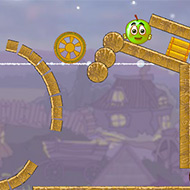
Slime does not work like any other platforming character you’ve controlled before — stick it against a wall and it clings there momentarily, squeeze it flat and it slides under a laser with room to spare, and none of that becomes intuitive until you’ve already died in a vat of purple acid at least once.
| Genre | Physics platformer |
| Levels | 15 (original), 18 in the Poki version with local multiplayer |
| Main Character | Slime |
| Hazards | Purple acid, lasers, spikes, spiked circles, quicksand |
Slime’s Unique Physics as the Core of the Game
The entire identity of Slime Laboratory comes from how its title character moves. Slime can stretch, flatten, and stick to surfaces in ways a normal platformer hero simply can’t, and levels are built specifically around exploiting those properties. A gap too wide to jump might instead require flattening Slime to squeeze beneath a low pipe, while a vertical shaft covered in lasers might demand sticking to one wall and slowly sliding down rather than attempting a risky jump across.
This isn’t just a cosmetic gimmick layered on top of standard platforming. The squeeze mechanic and wall-stick ability are functionally load-bearing — without understanding them, several levels become close to unsolvable, and the game leans on this early by introducing the mechanics gradually rather than dumping every ability on the player in level one.
Collecting floppy disks scattered through each level adds a layer beyond simple survival. They aren’t required to finish a stage, but players chasing a perfect run treat every disk as mandatory, which turns a straightforward escape-the-lab objective into something closer to a completionist challenge.
Hazards Unique to Slime Laboratory
Purple acid is the signature threat throughout the game — a rising pink-purple hazard that instantly kills Slime on contact and, in several levels, climbs steadily from below, forcing constant upward movement rather than careful exploration. Alongside it, lasers, spiked circles, quicksand, and burrowing enemies like the wasp and anglerfish each demand a slightly different response, meaning no two levels reward exactly the same strategy.
- Levels with rising acid often stack moving platforms directly above one another, and jumping onto the wrong one at the wrong moment can trap Slime between them.
- Spinning circles require patience rather than speed, since misjudging the rotation timing usually means landing directly on a hazard.
- Berry trees function as bounce points that help Slime clear spike-covered gaps, and recognizing them quickly saves considerable trial and error.
By the time you reach the later levels, the game starts combining hazards rather than introducing them one at a time — a shaft lined with lasers might also require a precise wall-stick maneuver while rising acid closes in from below, and that layering is where Slime Laboratory shifts from approachable to genuinely demanding.
Community Notes and What Divides Players
A frequently discussed quirk among players involves certain platform-related glitches, particularly around swinging platforms suspended over acid, where Slime’s crouch state can interact oddly with the platform’s edge. Some players view this as a minor flaw worth patching, while others treat exploiting these quirks as part of the speedrunning meta for the game, which is a genuinely divisive point in community discussions.
Casual explorers tend to take their time hunting down every floppy disk before moving forward, while speed-focused players skip collectibles entirely and focus purely on reaching each level’s finish flag as efficiently as possible. Both approaches are supported by the level design, since disks are optional rather than gating progress.
Frequently Asked Questions
How does the squeeze mechanic work in Slime Laboratory?
Squeezing flattens Slime’s body, reducing its height while increasing its width, which allows it to pass under low obstacles like pipes and lasers that would otherwise block a normal jump. It’s a core mechanic introduced early and required in several later levels involving tight vertical gaps.
What happens if Slime touches the purple acid?
Contact with purple acid results in instant death and a restart from the last checkpoint, and in levels where the acid rises continuously, players need to keep moving upward rather than pausing to explore, since the hazard doesn’t stop advancing.
Can Slime Laboratory be played with more than one person?
The Poki version of the game added local multiplayer support, expanding the original 15-level format to 18 levels total and allowing more than one player to navigate the lab’s hazards together rather than solo.
Slime Laboratory succeeds because its central character genuinely changes how platforming problems get solved, turning familiar obstacles like spikes and lasers into puzzles that demand stretching, squeezing, and sticking rather than simple jumping. Once purple acid starts rising behind you for the third time in a level, you’ll understand why players keep a checkpoint pad in sight at all times.