










Red Remover
 (Пока оценок нет)
 Loading...
Similar Games











Description
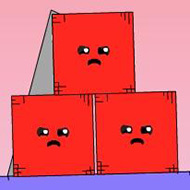
The green blob in Red Remover is the only shape on the board you’re never allowed to touch, and that single rule turns a game about popping shapes into a surprisingly sharp logic puzzle. Every level drops a tangle of red, light red, and green blobs onto a physics stage, and the entire challenge comes down to clicking things away in the right order without ever letting a green blob fall, tip, or get crushed.
| Genre | Physics puzzle |
| Platform | Browser |
| Levels | 40+ |
| Core goal | Remove red blobs, protect green blobs |
Light Red, Dark Red, and Green: Reading a Red Remover Board
Every board in Red Remover mixes three blob types, and the game expects you to know the difference at a glance before you click anything. Light red blobs pop the instant you touch them, no side effects beyond whatever their weight was holding up. Dark red blobs are stubborn: they refuse to pop on click and instead have to be physically dropped off the edge of the stage, which means you’re often clearing a path for them rather than removing them directly.
Green blobs are the one type you’re not fighting. They have to survive the entire sequence intact, still resting somewhere on the stage when the last red shape disappears. A green blob that falls off the bottom, gets squashed under a collapsing dark red, or tips into a pit ends the attempt immediately, which is why experienced players spend more time studying a board than clicking on it.
New players tend to click whatever’s easiest to remove first, which usually collapses the structure holding the green blob up before a safer sequence has been worked out. Reading which blob is load-bearing before touching anything is the actual skill Red Remover is testing.
Gravity That Points Sideways in Red Remover
Later boards stop behaving like a normal physics sandbox. Each shape carries its own gravity direction, marked by which way its face is pointing, so a blob can fall sideways or even upward once it’s freed from whatever was pinning it in place. This is the twist that separates early Red Remover levels from the ones that show up two-thirds into the level list.
A board where every blob falls the same direction is a puzzle about order. A board with mixed gravity is a puzzle about geometry, because removing one red blob can send a green blob sliding sideways into a completely different hazard than the one it started next to.
Explosive blocks show up in the same later stretch, and they don’t discriminate between colors when they go off. Timing a click near one wrong can wipe out a green blob you’d protected for the entire rest of the sequence.
Sequencing a Red Remover Level Before You Click
- Identify every green blob and what’s directly underneath it before removing anything
- Pop light red blobs first if they aren’t load-bearing for a green blob
- Save dark red blobs for last if their removal path could disturb something fragile
Most Red Remover levels have more than one valid solution, but only a narrow window of sequences that don’t accidentally sacrifice a green blob two or three moves in. Community discussion around the game tends to focus less on “the” answer and more on which order feels cleanest, since a working solution and an elegant one aren’t always the same clicks.
Players who treat each board like a stack-removal problem, working from the top down, generally do better than players who chase the most obvious red blob first. The habit of tracing support structures before committing to a click carries over from the early levels straight through to the boards with mixed gravity.
Building Levels of Your Own
- Place light red, dark red, and green blobs on an open stage
- Set each shape’s individual gravity direction
- Test the sequence yourself before sharing it
Red Remover ships with its own level editor, and a chunk of the game’s lasting appeal comes from boards built by other players rather than the original 40-plus. Community-made levels tend to lean harder into the sideways-gravity trick than the official set does, since regular players enjoy pushing the mechanic further once they understand it.
That user-made layer is also where the game’s reputation for genuinely difficult, borderline-unfair puzzles comes from — some fan levels are built specifically to punish the “pop the easy one first” habit that trips up newcomers on the official levels.
Red Remover stays a puzzle game about restraint as much as removal, and once you’ve sat through a board where a single misclick sends a green blob tumbling sideways off an explosive block, the appeal of its stripped-down physics starts to make sense.