






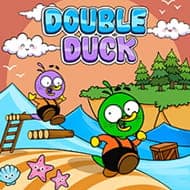
Double Duck
 (Пока оценок нет)
 Loading...
Similar Games






Description
You nudge the green duck forward one tile, and the purple one swings around behind it like a pendulum that never lets go. That tether between Mars and Phobos is the entire premise of Double Duck, and the first time it drags Phobos through a gap in a wall you thought was solid, you stop thinking of this as a normal platformer.
The Link Between Mars and Phobos
Every level in Double Duck asks you to manage two ducks at once, but not in the usual “switch between characters” sense. Mars and Phobos stay locked at a fixed distance, and pressing the rotate button swings Phobos clockwise around Mars in eight directions. If Mars is standing on solid ground and Phobos ends up mid-air, that’s fine — the link holds. If the space Phobos would rotate into is blocked, the move simply doesn’t happen, and figuring out which rotations are legal in a cramped room becomes the real game.
What surprises new players is how quickly this single rule stacks into genuine puzzles. A gap that looks impassable on foot becomes trivial once you realize Phobos can swing through the wall on the other side while Mars anchors the rotation. Community discussion around the game keeps circling back to this “anchor and swing” vocabulary, because there isn’t really another way to describe the technique once you’ve used it a dozen times.
Jump Pads and One-Way Blocks in Double Duck
Later stages introduce jump pads that only respond to one of the two ducks, plus blocks that only Phobos or only Mars can pass through depending on color. These additions don’t replace the rotation mechanic, they layer on top of it, and by level 7 or 8 you’re chaining rotations and jumps in the same three-second window. Beginners tend to get stuck here because they keep treating Mars as the “main” duck and Phobos as an afterthought, when several rooms are built specifically around leading with Phobos instead.
- Speedrunners aim to clear the campaign’s 11 levels without wasting a single rotation.
- Completionists chase every collectible heart tucked into dead-end rotation paths.
- Casual players tend to replay early levels just to feel out the timing again after a break.
The game runs natively on original Game Boy Color hardware, which matters more than it sounds like it should — the two-duck silhouette reads instantly even on the small, dim screen the console was built around.
What Trips Up New Players
The most common mistake is treating the tether as decoration instead of the actual puzzle mechanism. Once Phobos gets stuck against a wall corner, some players panic-jump instead of simply rotating the other direction, which usually makes the situation worse. Take a breath, rotate back, and the ducks separate cleanly almost every time.
What Reaching the Later Levels Feels Like
By the time you reach the last few stages, the game stops teaching new pieces and starts combining everything at once — one-way blocks, jump pads, and tight rotation windows in the same ten-second stretch. It’s a short game, but it earns its length by refusing to pad itself with filler rooms.
How does the rotation direction work in Double Duck?
Phobos always rotates clockwise around Mars when you press the rotate input, moving through eight fixed positions. You can’t rotate counter-clockwise directly, so planning a path sometimes means going three-quarters of the way around instead of a quarter turn the other way.
Can Phobos pass through walls during rotation?
Yes — this is the mechanic most new players miss. As long as the tile Phobos would land in during the rotation is open space, the rotation happens even if the path between the two ducks technically crosses solid terrain.
Is there an ending or story beyond the puzzles?
Double Duck keeps its narrative minimal; the focus is entirely on the 11-level puzzle campaign, with no cutscenes interrupting the rotation-based gameplay.
Double Duck earns its place among Game Boy Color puzzle games by committing fully to one idea instead of diluting it, and by the final level the sight of Mars and Phobos locked together no longer looks like a limitation — it looks like the only way this kind of level design could have worked.