






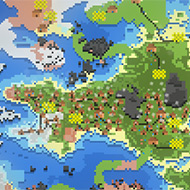
WorldBox
 (Пока оценок нет)
 Loading...
Similar Games






Description
What happens when a page called WorldBox turns out to have nothing to do with smiting tiny civilizations from above? Instead of a sandbox god-sim, a plain map loads up alongside a set of drawing tools and a single job: redraw the borders left behind after a fictionalized peace conference in 1919, one contested region at a time.
| Genre | Border-drawing strategy and diplomacy sim |
| Platform | Browser |
| Core Focus | Reassigning contested zones between two postwar factions |
| Player Count | Single player |
The Border-Drawing Reality Behind WorldBox
The premise borrows its shape from the real Paris peace talks without naming any actual country, which keeps WorldBox in comfortably fictional territory while still carrying the weight of the source material. You’re handed a simplified painting tool – left click for one faction’s color, right click for the other – and told to reassign a stretch of neutral land between the two sides shown on the map, red and blue.
There are seven side buttons mapped to number keys one through seven, covering things like undo, zoom, and the different paint modes, and once you’ve used them a handful of times the whole interface stops feeling like a puzzle in itself and starts feeling like an actual set of drawing tools. That’s important, because WorldBox never explains its scoring in more than a line or two – you’re expected to infer good practice from how a region reacts to your borders.
Early regions are forgiving. You can paint in broad strokes, hand over a rough chunk of land to red or blue, and still come away with a passing score. That changes fast. By the time you reach the regions with dense population clusters, sloppy borders start getting flagged, and the game wants you thinking about who actually lives where rather than just filling in the largest possible area for your preferred color.
Exclaves and the Push for a Clean Score in WorldBox
The mechanic that trips up almost everyone the first time is the exclave – a pocket of one faction’s territory left stranded inside the other’s land. Early on, exclaves are harmless; the game lets you erase them without penalty. Once you’re several regions in, though, exclaves start counting directly against a clean score, and by then the temptation to leave “just one small pocket” for later has usually already cost someone their best attempt at a region.
Getting a genuinely clean pass means balancing a short list of priorities at once:
- Keeping borders short and angular instead of winding around every small landmark
- Respecting the population distribution shown on the region overlay
- Avoiding new exclaves even when a stray pocket looks convenient to hand off
- Watching which faction, red or blue, is favored by the region’s political weight
Blue is consistently shown as the side that comes out of the war in the stronger position, which shapes how a lot of the later regions are weighted even before you draw a single line. That imbalance is one of the more debated aspects among players – some find it an honest reflection of how postwar borders actually got decided, others feel it nudges every late-region decision in one direction before the player gets a real say.
There’s a particular quiet to the whole process that a lot of players comment on: no explosions, no combat animations, just a paintbrush cursor and a map slowly settling into its final shape. Players who spend time in traditional 4X strategy games and complain about border gore – the term for borders that wander in illogical tendrils across a map – tend to find the whole process soothing, while players who came in expecting WorldBox to deliver constant action tend to bounce off within the first couple of regions.
Does WorldBox involve any combat or civilizations to manage?
No – despite the name, there’s no population simulation or unit control here. Every region is resolved entirely through border placement, not through managing armies or growing settlements.
What makes a border count as “clean” in WorldBox?
Short, angular lines that respect population distribution and avoid leaving exclaves behind score best. Curved, wandering borders and stranded pockets both count against you once a region’s later scoring kicks in.
Is there a way to undo mistakes while redrawing a region in WorldBox?
Yes – undo is mapped to one of the seven numbered side buttons, so a bad stroke on a contested border doesn’t have to mean restarting the whole region from scratch.
WorldBox ends up being less about scale and more about restraint, and the exclave is the clearest proof of that – a single leftover pocket of red or blue that turns a seemingly finished region into one more pass with the paintbrush.