









60 Seconds!
 (1 оценок, среднее: 5.00 из 5)
 Loading...
Similar Games





Description
In 60 Seconds you start with exactly one minute, a shaking house, and a mental list of family members and supplies you’ll never manage to grab all of, which matters more than anything you do once the bombs actually start falling.
| Genre | Survival adventure, dark comedy |
| Setting | Nuclear fallout shelter |
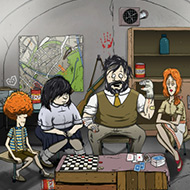
| Family Members | Ted, Dolores, Timmy, Mary Jane |
| Core Phases | Scavenge (60-second timer), then Survive |
The Scavenge Phase and What You Can Actually Carry
The entire premise hinges on that opening minute: Ted’s house is collapsing, the siren is blaring, and you control him running room to room grabbing whatever combination of family members, food, water, and supplies you can physically carry before the shelter door needs to close. Beginners consistently waste early seconds deciding rather than moving, and 60 Seconds punishes hesitation harder than almost any other single mechanic in the game — every wasted second scavenging is a resource or family member you won’t have underground.
Rationing Inside the Shelter
Once the door shuts, the game shifts entirely into a survival-management phase where food and water get rationed daily among however many of Ted, Dolores, Timmy, and Mary Jane made it inside. This is where the dark comedy tone really shows itself — random events pop up constantly, some absurd, some genuinely grim, and how you respond shapes both morale and how long your supplies actually stretch. Sending a family member out to scavenge the wasteland for more resources is often necessary, but it’s also a gamble, since the surface holds encounters that can go well or turn deadly with no reliable way to predict which.
- Players who enjoy tight resource math tend to obsess over exact food and water ratios per family member per day.
- More narrative-focused players lean into the random events for their dark humor rather than optimizing survival odds.
- Players chasing every possible ending replay the scavenge phase repeatedly to test different family and supply combinations.
The Randomness Players Argue About
The wasteland encounters are a frequent point of debate in community discussion — some players find the unpredictability part of the dark charm, since losing a family member to a bizarre random event fits the game’s tone, while others feel it can undercut careful planning when a well-provisioned shelter still ends badly due to bad luck on a scavenging trip. Both reactions show up constantly in reviews, and neither side is entirely wrong about how the randomness cuts both ways.
How many family members can you save in the initial scavenge?
All four of Ted, Dolores, Timmy, and Mary Jane can technically be saved if you move quickly and efficiently within the 60-second window, though most first attempts end up sacrificing at least one family member or a meaningful chunk of supplies to do it.
What happens if you don’t grab enough food and water?
Insufficient supplies force harsher rationing decisions almost immediately, and sending family members out to scavenge the wasteland becomes necessary far sooner, which increases exposure to the game’s often dangerous random encounters.
Are the random events during the survival phase fair?
Opinions differ — the events are designed for dark comedic unpredictability rather than strict fairness, and while some players enjoy that chaos as part of the tone, others find it can override otherwise solid resource planning.
60 Seconds never lets you forget that the real game happened in that first frantic minute — every ration you’re stretched thin on inside the shelter with Ted and whoever else made it traces directly back to what you did or didn’t grab before that door slammed shut.