














WILDERLOCKE

 (2 оценок, среднее: 3.00 из 5)
 Loading...
Similar Games







Description
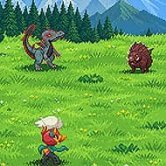
WILDERLOCKE looks like a familiar monster-taming adventure, with pixel-art creatures and turn-based battles, but it plays like a Nuzlocke challenge that never lets you reload. Every decision is permanent, every monster you lose stays lost, and an entire run can end on one careless turn. That tension is the whole pitch of the game.
| Genre | Tactical monster-taming roguelike |
| Battle format | 2v2 turn-based fights |
| Monsters | 100+ to discover and evolve |
| Moves and passives | 250+ moves and 80+ passives |
| Bosses | 12+ bosses with 48+ handpicked parties |
| Difficulty | 10+ levels of increasing challenge |
Nuzlocke Rules Meet Roguelike Runs in WILDERLOCKE
A Nuzlocke is a self-imposed challenge from monster-taming JRPGs in which a fallen monster is gone for good. The game takes that idea and builds it into the rules. Lose a monster during a battle and it is lost forever, and lose all of them and your run is over. There is no save file to rescue you, so every fight carries weight.
The roguelike half supplies the replay value. Each run produces a unique combination of opponents, encounters, and monsters, so no two attempts follow the same script. A team that worked beautifully last time may not even be available this time, which forces you to adapt instead of memorizing a route.
Veterans of Nuzlocke challenges will feel at home immediately. Newcomers should expect to lose runs early, and that is part of how the game teaches. Errors are costly, and the lesson usually arrives faster than the comfort.
Building a Monster: Four Moves, Two Passives, and Split Stats
Every monster carries a customizable set of 4 moves and 2 passives, and that small number is what makes choices matter. With more than 250 moves and over 80 passives to pick from, two copies of the same species can play in completely different ways. Half of a monster’s stats depend on its species, and the other half are set by you, so the same creature can be a supporting tank in one run and a fast damage dealer in the next.
That freedom creates a clear puzzle: what does this particular team need? A party made entirely of heavy hitters tends to crumble when one opponent stalls or applies a crippling status effect. The game supports several different approaches, and a team built around one of them usually beats a team built around none.
- Protect and strengthen one monster until it can carry the fight.
- Apply crippling status effects and let your opponents fall apart.
- Stall the fight and win through damage over time.
- Simply hit harder and faster than everyone else.
With more than 100 monsters available, theorycrafters will probably spend as much time in the build screen as in battle. That is a strength for anyone who loves optimizing, though it can feel overwhelming if you only want to pick a favorite and go.
2v2 Battles Without Luck
One of the biggest differences from classic monster-taming battles is that nothing is left to chance. There are no critical hits, no chance to miss, and no moves with random secondary effects. If a plan fails, the cause is your plan, not a bad roll. That is why players describe fights as puzzles that happen to be fought in real time against a team that reacts to you.
Battles are 2v2, so every turn involves two of your monsters and two opposing monsters at once. Positioning, protection, and combined damage matter more than raw strength. Field conditions such as weather add another layer, because you can adapt to the current conditions or set them yourself to favor your playstyle.
- Check the field conditions and ask who they help.
- Identify which opposing monster is the real threat this turn.
- Decide whether to protect, pressure, or set up a longer plan.
- Commit, knowing that no random effect will rescue a mistake.
This routine will feel strict at first, and it is meant to. Once you stop hoping for luck and start reading the board, losses feel earned and wins feel clean.
Bosses, Handpicked Parties, and Difficulty Levels
Bosses are where runs are decided. There are more than 12 of them, backed by over 48 handpicked parties and unique battle modifiers, so they do not behave like regular encounters. By the time you reach a boss with a modifier that bends the rules of the field, a team built on one clever trick will often be exposed. The boss fights reward teams that cover several approaches.
On top of that sit 10+ levels of increasing difficulty, aimed at challenging even experienced monster trainers. Early levels let you learn how passives and moves combine without punishing every misstep, while the higher levels demand almost perfect planning. Each step up changes how safely you can afford to experiment.
The most common beginner mistake is overfitting to the last boss, building a team that beats one party and then collapses against the next. Another is treating every monster as replaceable. Since losses are permanent, a careless sacrifice has a long shadow, and that is where many first runs end.
Unlocking Starters and Replay Value in WILDERLOCKE
Progress carries over even when a run does not. Win a run with a favorite monster and you unlock it as a starter, which gradually widens the set of strategies you can open with. That loop gives defeat a purpose, because each attempt teaches you something about a species, a passive, or a boss party.
Collectors will chase the full roster of more than 100 monsters, since every starter unlock adds a new way to begin a run. Min-maxers, on the other hand, will spend their time hunting the perfect pairing of four moves and two passives for the 2v2 format. Both groups end up replaying the same bosses with very different teams.
This structure suits short, intense sessions as much as long ones. A single run can end quickly if you play carelessly, and a strong run can stretch far longer. The unpredictability of encounters keeps the next attempt from feeling like a rerun.
Who Will Click With WILDERLOCKE and Who Will Bounce Off
The game is clearly built for players who enjoy hard choices and who accept the consequences. If you love the Nuzlocke challenge but dislike how much of it depends on random hits and misses, the removal of luck is a major selling point. If you want a relaxed collection adventure where nothing is ever lost, the permanent monster loss will probably feel punishing instead of exciting.
There is a real debate hiding here. Without critical hits or missed attacks, there are no lucky comebacks, so a bad matchup can feel hopeless in a way that random games avoid. Some players will see that as honest and fair, while others will miss the swing that luck provides. Either reaction is reasonable.
The game is still approaching its planned 2027 launch, with a playtest open for sign-ups and a demo promised ahead of it. That makes it a good moment to watch how players talk about balance and difficulty before committing.
WILDERLOCKE succeeds when a tight 2v2 plan, four well-chosen moves, and two carefully picked passives carry a team through a boss with a hostile battle modifier. Anyone who enjoys that feeling, and who is willing to say goodbye to a monster for good, will find a lot to chew on in every run.