














TOEM 2
 (1 оценок, среднее: 5.00 из 5)
 Loading...
Similar Games







Description
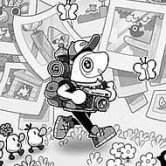
TOEM 2 looks like a quiet stroll through a charcoal sketch, but it plays like a patient investigation in which every photo you take counts as evidence. The camera is not a collectible here; it is the tool that opens paths, wakes up scenes, and answers questions the world keeps asking. Players who expect a slideshow soon find a puzzle game wearing a cozy coat.
| Genre | Photography adventure |
| Perspective | Top-down exploration with a first-person photo view |
| Palette | Black and white |
| Progress | Stamps, journal entries, critter compendium |
| Pace | No timers, no required full completion |
| Platform | PC (Steam), Steam Deck Verified |
How the Camera Switch Works in TOEM 2
Most of your time is spent running, jumping, and climbing through a top-down 2.5D view, which makes the world feel like a diorama you can poke at. Raise the camera and the view flips to first person so you can compose the shot yourself. That swap is the signature trick of the game, and it changes how you read every scene.
Beginners often snap the first interesting thing they see and keep walking. The better habit is to raise the camera at the edge of a new area, turn slowly, and look for details that feel out of place, such as an odd shape on a distant ledge or a resident waiting to be noticed. A photo in this game is rarely just a photo; it is usually a solution.
Early in the game the lessons stay simple and the camera forgives sloppy framing. Once attachments enter the picture, the challenge shifts toward combining what you see with what you can change, and that is where careful players start to pull ahead.
Hunting TOEMs Instead of Chasing Objectives
The mysterious events called TOEMs drive the whole trip. You are not following a checklist of enemies or a countdown; you are following curiosity toward something strange that needs to be photographed. Each TOEM has its own small story, usually built around a resident who needs a hand or a scene that only makes sense once you frame it properly.
This is where the cast of quirky characters and adorable critters earns its place. Lending a hand to a new face builds a friendship, and those friendships feed the memories you catalogue along the way. Social players who love chatting with everyone will find the slow conversations as rewarding as the puzzles.
One honest caveat: because the pace is intentionally gentle, players who want escalating challenge may find some TOEMs too easy. The game trades difficulty for discovery, and not everyone agrees that is the right trade.
Camera Attachments and Puzzles That Ask for More Than a Snap
The upgraded camera is the biggest step beyond the first TOEM. Attachments let you solve problems in each region in ways a plain shutter cannot, so a puzzle might ask you to alter the scene before you capture it. The result is a loop of look, change, then shoot.
This is also where the community debates the most. Photography puzzles can stumble when the intended shot depends on a detail that is hard to spot, and in a black-and-white world an invisible-pixel moment is a real risk. Players tend to trade tips about where to stand, how far to zoom, and which angle the game seems to want.
Puzzle fans should treat each region as a fresh toolbox rather than assuming the last attachment will solve the next obstacle. Testing a new attachment on every strange object is usually the fastest route to an answer.
Stamps, the Journal, and the Critter Compendium
Progress is recorded rather than scored. Instead of a number climbing on screen, you fill a journal with marks of what you have done, and nothing forces you to fill every page.
Stamps are the headline reward, earned by completing quests, documenting discoveries, and helping residents, so almost any activity can lead to one.
The journal works as your running record, which makes it the first place to look when you feel lost.
The critter compendium turns wildlife spotting into a collecting hobby, and completionists will happily spend an evening hunting the last entry.
Black and White, No Clock: Setting Your Own Pace in TOEM 2
The black-and-white look is a bold choice for a photography adventure, since color is usually the first thing a photo gets praised for. Here, shape and contrast do the work, and the simplicity gives the world a calm that suits slow exploration. Some players adore the pencil-sketch feel, while others wish color helped them tell a clue from decoration.
There is no timer and no hard requirement to finish everything. You can sit on a bench and listen to the music, stop to smell the flowers, or wander toward a viewpoint just because it looks inviting. That open pacing is why the game suits short handheld sessions so well.
Players who treat it as an evening wind-down tend to get the most from its rhythm, one region and one TOEM at a time. Rushing misses the point, because the game is designed to reward the person who lingers.
Where Patience Pays and Where It Wears Thin
Patience pays whenever a scene hides its answer in a small detail. Slow down, rotate the view, zoom in, and the solution often reveals itself. Photography fans in particular will enjoy lining up shots that both look good and work.
It wears thin when the expected framing is not obvious, because nothing on screen pushes you forward and a stuck moment can feel long. Walking away and returning with fresh eyes usually works better than snapping the same angle repeatedly.
The balance between wandering and solving is the real test of this style of game. Those who enjoy the wander will forgive a stubborn puzzle, while those who want constant direction may feel the quiet more than the charm.
TOEM 2 is at its best when you stop treating the stamps as a to-do list and start treating the camera as a way of looking. Chasing the next TOEM, filling the critter compendium, and testing a new attachment on a stubborn obstacle all reward the same instinct: slow down, notice, and take the shot.