






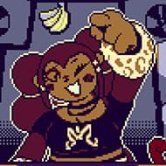
MOXIE // Graffiti Burst
 (1 оценок, среднее: 5.00 из 5)
 Loading...
Similar Games





Description
You drop off a rail mid-combo, thumb still on the trick input, and the score ticks up before your wheels even touch the ground again. That instant — chaining a grind into a trick without losing your run — is the whole pitch of MOXIE // Graffiti Burst. It’s a skate-n-tag platformer built for the Game Boy Color, and it wants you thinking about momentum before it ever asks you to think about danger.
| Genre | Platformer / Skating |
| Platform | HTML5 browser, GBC, CIA, Pocket |
| Levels | 20 levels across 5 areas |
| Core loop | Grind, tag, and chain combos for a rank |
Veve’s Route Through the Mischievous South
Ve’Ondre “Veve” Belle isn’t skating for fun — she’s chasing a spot in an illegal tournament, and every level rehearses that goal. The Mischievous South is drawn as a cramped, layered city where rooftops connect to rail networks, and rail networks drop into alley shortcuts hiding a tag spot you’d miss on a first pass.
Beginners tend to treat levels like a normal platformer, stopping to line up each landing. That’s the wrong instinct. Grinding is the actual traversal tool, and stopping to reposition kills the combo meter the scoring system runs on.
Controls stay simple — A to jump, B to tag — but the timing window for chaining a trick into a grind is tighter than it looks, and landing it cleanly is what separates a C-Rank clear from something higher.
Grading From C-Rank to S-Rank
Every level hands you a letter grade running from C-Rank up to S-Rank, and that grade is where the game quietly becomes a scoring game rather than a straightforward platformer. Reaching the exit isn’t the goal; reaching it with your combo intact is.
- Grinding rails keeps your multiplier alive longer than jumping between platforms
- Tagging big spots with B adds a flat score bonus separate from your combo
- Tricks performed mid-grind stack on top of the base grind score
- Dropping through platforms with Down lets you bail into a lower route without breaking flow
This is where community vocabulary shows up — players talk about a “flow route” through a level, meaning the specific chain of rails and tag spots that keeps a combo alive start to finish.
MOXIE the Crew Versus DAZE
The story wraps around a turf rivalry rather than a generic villain arc. Veve’s own crew, MOXIE, is a loose group of colourful misfits backing her push to become the new queen of the underground scene. Standing in her way is DAZE, the rival crew currently running that scene, treated less like a final boss and more like constant background pressure.
Story beats land between level clusters, so the game never interrupts a run to remind you why you’re doing this — you’re either skating or watching a short scene, never both.
Peckington, Gina, and the Escalating Threat
The city’s president, Peckington, starts as background nuisance — a crazed hare more worried about image than a teenage skater breaking curfew. That changes by the later areas, when Peckington sends in Gina, known in-game as the Hound Killer, armed with a rifle and a helicopter.
Gina’s arrival marks where difficulty stops being about clean trick execution and starts being about route planning under pressure. Some players call this late-game shift an abrupt genre pivot from a pure score-chaser into something closer to a chase game, and it’s one of the more divisive things regulars bring up in the comments.
One detail only players who’ve spent real time past that point tend to notice: the background palette turns noticeably colder once Gina starts appearing, a small environmental cue several commenters have pointed out.
Branching Paths and What Beginners Miss
Levels unlock by clearing the one before, but several stages also hand you a branching split, letting you choose one of two paths and skip the other entirely on that run. New players often don’t realize a branch existed until they’ve already committed.
The most common beginner mistake isn’t a missed jump — it’s over-committing to tagging every wall spot on a first attempt. Since tagging costs a beat of momentum, hunting every tag before learning the layout usually tanks your combo. Speedrunners and completionists end up wanting different things from the same short level, which keeps replay value high.
What New Skaters Ask About MOXIE // Graffiti Burst
How many levels does MOXIE // Graffiti Burst have?
The full release contains 20 levels split across 5 areas, roughly three to five stages each. The demo includes 9 of those levels, enough to show the core skate-and-tag loop and a couple of level gimmicks.
Do you have to hit S-Rank to progress?
No — clearing a level at any grade unlocks the next one or the next branch. S-Rank chasing is for players mastering a route, not a requirement to reach Veve’s confrontation with DAZE.
Is it hard for newcomers to skating games?
It’s forgiving early on, since the first area is mostly about learning the grind-and-tag rhythm. The curve steepens once Gina enters the picture, where route reading matters as much as trick timing.
By the time Veve is dodging a helicopter spotlight instead of outrunning bored guards, MOXIE // Graffiti Burst has shifted from a score-chasing skate game into something closer to a pursuit, without ever taking the controller away from you. Whether you’re replaying a stage for a cleaner flow route or hunting every tag spot in the Mischievous South, Veve’s rivalry with DAZE gives you a reason to keep pushing past your last S-Rank.