









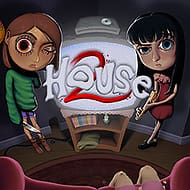
House 2 Demo
 (1 оценок, среднее: 5.00 из 5)
 Loading...
Similar Games







Description
Dolly, the porcelain-faced doll propped in the upstairs bedroom, does nothing the first time you walk past her — walk past twice, and she’s turned to face the door instead. That single detail is the entire pitch of House 2 Demo in miniature: a shorter slice of the house, built specifically to prove the game is paying attention even when the runtime is compressed.
A Condensed Slice of Tabby’s House
House 2 Demo keeps its scope narrow on purpose, following Tabby through a handful of connected rooms rather than the full sprawl of the finished story. What it preserves faithfully is the core idea behind the design: nothing resets once you’ve disturbed it, and the house’s reactions to your choices carry forward within the session even though the story itself is deliberately cut short. Players coming in expecting a stripped-down tutorial loop tend to be surprised by how much of the full house’s logic survives the smaller footprint.
Because the slice is short, players who treat it like a quick scare-hunt tend to miss the more interesting parts. Slowing down, testing item combinations, and paying attention to small changes in the environment gets you more out of the demo than rushing toward the exit ever will. Completionist-minded players in particular tend to replay the demo two or three times just to see how many of the small environmental shifts they missed on the first pass — a habit that maps directly onto how the full story rewards attention over speed.
Speedrun-minded players, by contrast, often treat the demo as a benchmark for how fast the opening rooms can be cleared, and the two approaches produce noticeably different impressions of the same handful of rooms. That split is one of the more interesting things about the demo as a piece of standalone content — it’s small enough that both playstyles can fully express themselves inside it, which isn’t something every horror demo manages.
What Carries Over in Skill, Not in Save Data
Nothing you do in the demo persists into a separate playthrough of the full game — the value here is entirely in learning the house’s habits before committing to the longer story. Players who spent time with the demo consistently describe recognizing the same behavioral logic once they start the full narrative, even in rooms they’ve never technically seen before, since the underlying rules governing how disturbances escalate stay consistent across both.
By the time the storm outside reaches its loudest point near the end of the demo’s short arc, most players have already picked up the game’s central lesson without being told directly: lingering after something’s been disturbed is riskier than moving on. This is roughly the moment community discussion around the demo tends to reference when describing its pacing — a short but deliberate build toward pressure rather than a flat stretch of exploration followed by one big scare.
Newcomers to the house’s particular brand of horror often describe this transition as the point where the demo “clicks,” while players already familiar with the original House recognize it faster, since the underlying rhythm of provoke-then-retreat carries over from the first game almost unchanged. That familiarity is part of why the demo functions well as a standalone taste rather than feeling like an arbitrary slice cut out of a longer story.
Dolly, Sound Cues, and Reading the Room
Dolly isn’t the only signal worth watching. Marty the snail tags along here too, and his small physical reactions — a flinch, a sudden retreat — work as an early-warning system the demo introduces without any tutorial text explaining it outright. Community discussion around the demo has focused heavily on how many players miss Marty’s cues entirely on a first pass, only noticing them once they know to look, which has turned “watch the snail” into a small piece of shorthand players repeat to each other in early impressions.
The demo’s compressed scope means these cues get less room to breathe than they would in the full story, which is a fair criticism some players raise — a longer runtime might have let the house’s reactivity land with more weight. It’s a legitimate trade-off rather than a flaw exactly, since a longer demo would risk giving away pacing beats better experienced fresh in the full release.
Sound design carries more of the tension than visuals do in these early rooms, and players who play with headphones consistently report catching Dolly’s positional shift and other small cues faster than those relying on speakers alone. It’s a small, practical detail, but one the demo leans on more than its short runtime might suggest at first glance.
Deciding Whether to Move to the Full Story
For players wondering whether House 2 Demo accurately represents the pacing of the full game, the honest answer is that it does, within its shorter window — the escalation feels real, even compressed. Whether Melody appears in this shorter scope isn’t something the demo confirms one way or the other, since her sections in the full story unlock later than the demo’s cutoff point ever reaches.
Players who finish the demo in under fifteen minutes and come away unimpressed are usually the ones who rushed the environmental details rather than the ones who genuinely dislike the pacing, which is worth keeping in mind before writing the demo off entirely on a first quick run.
Does progress carry over from House 2 Demo to the full game?
No — the demo and the full story run as separate experiences, so nothing you unlock or discover here transfers directly, though the habits you build with Marty and the house’s reactive systems absolutely do, and most returning players say that carried instinct is worth more than any item unlock would have been anyway.
Is Melody playable in the demo?
The demo’s shorter scope keeps its focus on Tabby, staying within the earlier stretch of the story where Melody hasn’t yet entered the picture, so there’s no way to access her sections within this preview build regardless of how far a player explores.
Is the demo worth playing before buying the full game?
Yes, particularly for judging whether the house’s fast, reactive pacing suits you — that’s the one thing the demo represents honestly, even in a shorter form, and it’s a far better indicator of fit than trailers alone tend to be for this specific style of horror game.
Between Dolly’s slow, patient menace and Marty’s easy-to-miss warnings, House 2 Demo does what a good preview should: it hands you just enough of the house’s logic to know whether you want the rest of it.