










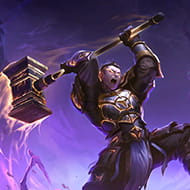
Hellforged Demo
 (1 оценок, среднее: 5.00 из 5)
 Loading...
Similar Games










Description
You extract mid-fight with a legendary item glowing in your inventory, demons still closing in behind you, and for a second the only decision that matters is whether to risk one more room. Hellforged Demo builds its entire tension around that exact choice, over and over, until the hesitation itself becomes the real enemy.
| Genre | Extraction bullet-heaven action RPG |
| Platform | PC |
| Core Mechanic | Fight demon hordes, loot gear, and choose when to extract |
| Difficulty Tiers | Normal, Heroic, Mythic, and a fourth tier some players feel is missing entirely |
The Undercrypt and the Shattered Blackpyre
Hellforged Demo drops you into the Undercrypt as one of the survivors of a failed expedition into the Blackpyre, and the framing device matters more than it first appears — every run is explicitly a heist, not a straightforward dungeon clear. That heist framing changes how players approach fights, since the goal is never simply to kill everything on screen.
Early in the game, before you’ve unlocked meaningful Arsenal options, most runs are about surviving long enough to understand which threats are worth fighting and which are worth routing around entirely. Players who treat the opening minutes like a standard bullet-heaven power fantasy tend to overextend and lose gear they never needed to risk.
Building Your Run Before You Even Start
Arsenal deck is the pre-run build system that lets you handpick which upgrades and abilities are eligible to drop during your expedition, rather than leaving it to pure chance the way most bullet-heaven games do. Committing to an Arsenal deck before entering the Blackpyre is the single decision that shapes an entire run more than anything you do once you’re inside.
This is also where Hellforged Demo separates itself from genre peers — the community vocabulary around “deck-locking” a run has already formed, referring to picking a narrow, synergy-focused Arsenal rather than a flexible generalist one. Build-focused players swear by deck-locking for consistency, while newer players usually benefit more from a generalist deck that forgives mistakes.
Once you’ve unlocked a wider pool of Arsenal cards, the temptation is to chase every synergy at once, but experienced players tend to settle on two or three core interactions and build the rest of the run around protecting those, rather than diluting a deck across too many half-formed combos.
Extraction: The Decision That Actually Matters
Once you’ve captured locations, cracked chests, or cleared a rift, Hellforged Demo forces the same question every time: extract now with what you’ve got, or push further and risk losing it all. This decision is the game’s real skill test, more than any single combat encounter.
Cautious players extract the moment they’ve secured one solid upgrade; risk-tolerant players chase rifts for endgame resources even when the horde around them is clearly winning. Neither approach is wrong, but the difficulty spike between Normal and Heroic difficulty makes the risk-tolerant approach considerably less forgiving than it looks on paper.
By the time a run reaches its later minutes, extraction stops being a simple binary and becomes a question of positioning — you need a clear path back to the extraction point, not just the will to leave, and that’s a distinction beginners often miss until it costs them a full inventory.
Synergies and the Eternal Tree
Ability synergies are where Hellforged Demo rewards players who plan rather than improvise — combining the right modifiers can turn a mediocre weapon into the centerpiece of an entire run. The Eternal Tree talent system sits above individual runs, letting persistent progress carry over even after a failed extraction, which softens the sting of losing gear mid-heist.
One honest weak point players raise often: once you’ve pushed into Mythic difficulty, the jump in incoming damage from falling hazards and mob density can feel closer to random punishment than a fair test of build quality, and that criticism shows up regularly in community discussion. Some players fully upgraded on legendary gear still report lasting barely a minute or two once Mythic’s hazard density kicks in, which has fueled ongoing debate about whether the difficulty ladder needs an additional rung between Heroic and Mythic.
Reading Enemy Density Before You Commit
- Light hordes early in a run are safe to fight directly and often worth the loot
- Dense mob clusters near rift entrances usually signal a resource worth the risk, but require an escape route planned in advance
- Falling hazard zones on Mythic difficulty are best avoided entirely rather than fought through
Ignoring density cues is one of the fastest ways to lose a promising run — players who push into a cluster without an extraction path already in mind tend to lose everything in the same fight that was supposed to make the run worthwhile.
The Monthly Trial System
Once a month, a new Trial reshapes the run around a specific sin-themed gauntlet — greed, wrath, and others in rotation — giving players a reason to return even after clearing the standard difficulty tiers. Climbing the live leaderboard during a Trial period is currently the main competitive hook Hellforged Demo offers outside of personal build experimentation.
Leaderboard-focused players treat each Trial as a fresh optimization puzzle, since the sin-specific modifiers often invalidate whatever deck worked best the previous month, while more casual players tend to dip in only for the exclusive titles attached to a strong placement.
Is Hellforged Demo free to play?
Yes, the demo is free on Steam and offers an exclusive first look at the Blackpyre ahead of full release, with no reason to skip trying the extraction loop before committing to the full game.
What happens if I lose a fight before extracting?
You lose the gear collected during that specific run, though Eternal Tree progress persists regardless, so a bad extraction never resets everything you’ve earned.
Should I play Normal or jump straight to Heroic?
Normal is the recommended starting point for learning Arsenal deck construction without punishing experimentation, since Heroic and especially Mythic sharply increase the cost of a misjudged extraction.
What makes Hellforged Demo worth returning to isn’t just the demon count or the loot tables — it’s that the extraction decision at the edge of the Undercrypt never gets easier, no matter how many legendary items you’ve already banked in the Eternal Tree.