










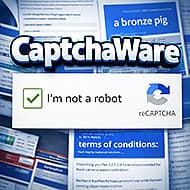
CaptchaWare
 (1 оценок, среднее: 5.00 из 5)
 Loading...
Similar Games





Description
The developer of CaptchaWare set their own high score at 77, and that single number tells you everything about how brutal the difficulty curve gets. What starts as clicking traffic lights turns into a blur of contradictory instructions before you’ve had time to catch your breath, and most players don’t realize how fast that escalation hits until they’re already three lives down.
| Genre | Microgame arcade / reflex |
| Platform | Browser |
| Core Mechanic | Solve rapid-fire captcha-style microgames before time runs out |
| Developer | Paper Hat Projects |
The Microgame Format Behind CaptchaWare
Each round in CaptchaWare lasts only a few seconds — long enough to read the prompt, not long enough to second-guess it. That WarioWare-style pacing is the defining feature of the game, and it’s exactly why so many players describe their first run as a blur they barely survived. Miss the prompt, lose a life; miss enough of them, and the run ends.
New players consistently make the same mistake: they try to read every word of the instruction before acting. CaptchaWare punishes hesitation specifically, so the players who last longest are the ones who react to the shape of the task before finishing the sentence describing it. That difference between reading and reacting is the single biggest skill gap between a run that ends at ten and one that clears thirty.
By the time you’ve cleared the first ten or so microgames, the prompts stop being straightforward image selection and start throwing in intentionally misleading instructions, which is where most first attempts fall apart. The jump in difficulty isn’t gradual — it arrives as a sudden shift in tone, and players who don’t adjust their reflexes immediately tend to lose two or three lives in quick succession.
Reading the Impossible Quiz Reference in CaptchaWare
Veteran browser-game players tend to spot it immediately: one of the later microgame variants is a direct nod to The Impossible Quiz, and CaptchaWare leans into that lineage rather than hiding it. Casual players who’ve never touched that older format usually get blindsided the first time logic stops applying and the “correct” answer becomes something absurd instead.
Speedrun-focused players treat this section as a memorization checkpoint rather than a puzzle, since replaying it enough times turns the trick answers into muscle memory. Completionist players, by contrast, tend to slow down deliberately here just to read every joke on screen, even knowing it costs them a life or two.
What makes this stretch divisive in the community is exactly that tension — some players find the logic-breaking humor the best part of CaptchaWare, while others feel it undercuts the pure reflex challenge the rest of the game is built around.
Escalation and the Phone Call Microgame
- Early microgames rely on straightforward object recognition, similar to a standard captcha grid
- Mid-run microgames start reversing instructions or adding a decoy element
- The phone call sequence near the later stretch requires picking the correct number under time pressure, and getting it wrong ends the streak instantly
The phone call moment gets brought up constantly in comment threads, mostly because nothing earlier in CaptchaWare prepares you for how specific the correct answer needs to be. It’s a single microgame, but it functions almost like a soft difficulty wall — plenty of otherwise solid runs end right there.
Players who’ve cleared it more than once generally agree on one detail: the correct number isn’t randomized in a way that rewards guessing, so treating it as a puzzle rather than a reflex test is the only reliable approach.
Building Consistency Across Repeated Runs
Because CaptchaWare shuffles pacing and microgame order slightly between attempts, no two runs feel identical, but certain patterns do repeat often enough to learn. Recognizing the visual style of an incoming decoy microgame half a second before the prompt fully loads is the kind of small edge that separates a mid-twenties score from a run pushing toward forty.
Casual players tend to treat every run as a fresh gamble, which is fine for a few minutes of fun, but players chasing a real high score usually keep a mental log of which microgame types tripped them up last time and adjust their reaction habits accordingly.
Chasing the Developer’s Score of 77
What’s a good score for a first run?
Clearing into the twenties is considered solid for a first attempt; the developer’s own record of 77 is treated as an end-goal benchmark rather than a realistic early target.
Does the difficulty keep escalating indefinitely?
Yes, CaptchaWare accelerates continuously rather than plateauing, which is part of why runs rarely feel repetitive even on a second or third attempt.
Is there a way to practice specific microgames?
Not directly — since order and pacing shift each run, players mostly build familiarity through repeated attempts rather than isolated practice, though certain later-game variants like the phone call sequence do reappear often enough to study.
CaptchaWare turns a genuinely annoying piece of internet infrastructure into something people voluntarily chase a high score in, and once the phone call sequence has humbled you once, coming back to beat your own number — and eventually the developer’s 77 — becomes the whole point.