













Absurd Trolley Problem
 (1 оценок, среднее: 5.00 из 5)
 Loading...
Similar Games











Description
What happens when a classic philosophy puzzle stops being a clean choice between five people and one? Absurd Trolley Problem answers by handing you the same lever again and again while the tracks fill up with lobsters, a cat, a rich man waving $500,000, and the original Mona Lisa. The setup starts as a textbook thought experiment and then stops respecting its own rules almost immediately.
| Genre | Moral dilemma, interactive thought experiment |
| Platform | Browser, desktop and mobile |
| Controls | Click or tap the lever |
| Length | Roughly 30 dilemmas in one run |
One Lever, Two Tracks: The Choice in Absurd Trolley Problem
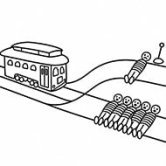
Every dilemma uses the same frame. A trolley rolls toward a group of people on the main track, a lever sits beside you, and a second track waits on the other side. Pull the lever and the trolley switches tracks. Leave it alone and the trolley keeps going straight, so the default outcome is always the one you did not choose to change. That small detail makes the game feel heavier than its cartoon look suggests.
Most players treat the first dilemma as a warm-up: five people on the main track, one on the side track, and an easy pull. Within the first few dilemmas the numbers flip, and the lever now sends the trolley toward four people instead of one. Beginners who memorized the rule “pull to save the most people” discover that the rule only works while the tracks stay balanced.
The run covers roughly 30 dilemmas, and none of them tells you whether you chose well.
When the Tracks Stop Being About Numbers
Once the game moves past headcounts, the cost lands on you. One dilemma lets you divert the trolley only by sacrificing yourself, another by destroying your life savings, and another by losing the original Mona Lisa. These are not harder versions of the same math problem. They ask whether you value strangers over your own security, and over art that belongs to everyone.
The rich man dilemma is where many players hesitate longest. The trolley is heading toward him, and he offers $500,000 if you pull the lever and send it into someone else instead. No one on the tracks is clearly worse than anyone else, so the only variable is money. By the time the rich man appears, you have usually settled into a pattern, and the bribe tests whether that pattern was ever a principle. Players who enjoy moral philosophy tend to like this stretch most, because it separates rule-based answers from outcome-based ones.
Pay attention to the pause after you commit. The trolley is already moving, the choice is locked, and the short wait before impact is the moment most players say they remember.
The Lobsters, the Cat, and the Argument Players Keep Having
The lobster dilemma is the one people bring up first. Five lobsters sit on the main track and a single cat sits on the side track, so pulling the lever means choosing a pet over a larger number of animals. Discussion splits fast: some count heads, some value the cat, and some point out that lobsters are mostly seen as dinner. Nobody agrees, and that disagreement is what the game really produces.
Honestly, this is also where some players push back. When the dilemmas turn into jokes, the weight of the earlier ones can drain away, and a few people feel the game treats death too lightly once the absurdity takes over. Others argue that the humor is the point, since it exposes how arbitrary your instincts are.
Streamers and friends playing together get the most from this section, because the argument over the lever matters more than the lever itself. Completion-minded players will notice there is no correct route to chase, which is a deliberate frustration.
Playing Absurd Trolley Problem Without a Right Answer
The most useful technique is to decide your principle before the strange dilemmas arrive, then watch where it breaks. If you pull the lever to save five people, ask yourself whether you still pull it when your life savings are on the line, or when the lever sends the trolley toward the one person you would never choose.
A second run teaches more than the first. Flip every answer and the same dilemmas read differently, because you notice which choices were convictions and which were reflexes. Many players report that their second pass feels less like a game and more like an audit of their own habits.
Early in the game, quick clicking feels natural, but the later dilemmas reward slowing down. Once the lobsters and the rich man show up, the players who read the situation twice tend to give the answers they can actually defend afterward.
Questions About Absurd Trolley Problem
- How many dilemmas are in Absurd Trolley Problem? A single run covers roughly 30 dilemmas, starting with the classic five-versus-one lever and moving toward the lobsters, the rich man, and the Mona Lisa. It is short enough to finish in one sitting and replay with different answers.
- Is there a right answer in Absurd Trolley Problem? No. The game never scores you, and the same lever that saves five people can later cost you your life savings or your own life. The only thing that matters is whether your answers stay consistent with what you say you value.
- What happens if you do not pull the lever? The trolley continues along the main track and hits whoever is standing there, whether that is five people or five lobsters. Doing nothing is still a decision with a visible result, which is exactly the point of the lever.
The lever keeps asking the same question in different clothes, and Absurd Trolley Problem is at its best when the lobsters, the rich man, and the Mona Lisa make you notice which of your answers were principles and which were only reactions.