














MONOMOON
 (1 оценок, среднее: 5.00 из 5)
 Loading...
Similar Games



Description
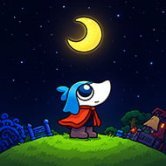
In MONOMOON you begin as a little creature with a crescent moon hovering beside you, in a small world with no dialogue, no combat, and no written instructions, and that detail shapes every minute that follows. Nothing tells you where to go, what to touch, or which of your two controllable halves is supposed to do the work. The moon in the sky has cracked apart and its pieces are scattered, and putting it back together is the one goal the game states, using pictures instead of sentences.
| Genre | Puzzle adventure with Metroidvania-style exploration, often called a Metroidbrainia |
| Platform | PC |
| Players | Single-player |
| Controls | Keyboard and mouse recommended, controller supported |
| Combat and dialogue | None of either |
| Main path length | Around ten hours by the store estimate |
Reading a World Without Words in MONOMOON
Because there is no dialogue, every room works as its own lesson. Items sit in plain view, pathways hide behind things that look like decoration, and small clues wait in corners that a hurried player scrolls straight past. Early in the game the best habit is to stop on each new screen and look before you move, since the answer to a puzzle is often already in the room you are standing in. This is what players mean by Metroidbrainia: the thing that opens a door is not an upgrade but something you finally understood.
That is a different rhythm from a standard Metroidvania, and fans of the genre notice it quickly. There is no boss to beat and no ability to farm, so progress is measured in realizations rather than power. Players who arrive expecting a map full of locked gates and a satisfying new jump need a few minutes to adjust, and that adjustment is the first real hurdle.
The soft piano melody that plays from the moment you open the game sets the tone, dreamy and a little like a bedtime story. Nothing here pressures you, and that quiet is a big part of why the puzzles invite slow thinking instead of panic.
The Moon, the Book, and the Little Creature Working Together
Your crescent moon. You steer it with the mouse while the creature moves with the keyboard, which means you are always controlling two things at once. Its blue glow lights dark passageways, helps with platforming, and reveals secrets that stay invisible on the pages of the book. Players who treat the moon as a simple lantern miss most of what it can do, so try shining it on everything.
The little creature. It jumps, climbs, and interacts, but it never fights. The other creatures you meet are part of the puzzles instead of obstacles, and interacting with them unlocks new areas and new mechanics. This is how the game keeps a world full of inhabitants without a single enemy encounter.
The book and its symbols. The book collects pages that range from direct guidance on creature interactions to cryptic diagrams, along with a numerical language made of symbols. Reopen it constantly, because the page that looked meaningless an hour ago often explains the room in front of you. The painted scenes you can enter also give some players a flashback to classic 3D platformers.
Where MONOMOON Tests Your Patience
The store description says you have no proper instructions and must deduce your goals, and that is exactly as demanding as it sounds. There is no hint system, so being stuck means being stuck until you notice something new. The most common beginner mistake is rushing forward and leaving a clue behind, and the second is forgetting the book exists once you walk away from its pages.
The control split is the aspect players weigh most. Controller support exists, but the game is built around the two-handed pairing of keyboard movement and mouse-guided moonlight, so anyone who dislikes that setup should expect an adjustment period.
The symbol language divides people too. Some players love decoding it with a notepad beside the keyboard, while others find it opaque enough to feel like homework. The store page notes that every puzzle can be solved alone and that all clues live inside the game, yet it also encourages comparing notes with a friend.
What Waits Past the Credits in MONOMOON
The main path is advertised at around ten hours, and the credits are not the end of the game. Beneath the obvious route sit layers of secrets, from simple puzzles to cryptic mysteries and hidden mechanics, and the deepest ones only show up for players who keep exploring after the story wraps.
Difficulty rises less through harder jumps and more through puzzles that connect to one another. A page of the book you read early can turn out to matter in a distant corner of the map, which is why the later secrets feel earned instead of arbitrary.
Completionists will get the most from this stretch, since the extra layers reward careful note-taking and a willingness to try odd things with the moon. If you only want the main story, you can stop at the credits and still have a complete adventure.
Questions Players Ask Before Starting MONOMOON
How long does MONOMOON take to finish?
The store estimate for the main quests is around ten hours, though your pace depends on how quickly the book and the moon start making sense. Players who chase the hidden layers after the credits will spend noticeably longer exploring the same small map.
Is there combat in MONOMOON?
No. There are no enemies to fight and no dialogue to read, so every obstacle is a puzzle, a platforming problem, or an interaction with one of the creatures. The moon is a tool for revealing and traversing, not a weapon.
Can you solve MONOMOON without a guide?
Yes, by design. Every clue exists inside the game, whether in a room, on a page of the book, or in how a creature reacts, so a patient player with a notepad can solve everything alone. Talking through a stubborn puzzle with a friend is encouraged but never required.
MONOMOON rewards the player who shines the moon across one more page of the book, copies down one more strange symbol, and trusts that the answer is already on the screen. It is a small world with a long memory, and every restored piece of the broken moon makes the next secret feel closer.