














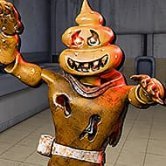
Poopy’s Playland
 (1 оценок, среднее: 5.00 из 5)
 Loading...
Similar Games












Description
You push through the gate of an abandoned playland with a flashlight in your hand and a year of unanswered questions behind you, and Poopy’s Playland has not shown you a single killer mascot yet. Your child went missing in this building twelve months ago, the lights are dead, and the only thing left to do is walk in. That setup is more personal than most horror games bother to be, and it explains why the mood hits harder than the colorful look suggests.
| Genre | First-person horror adventure with puzzles and stealth |
| Protagonist | A grieving mother searching for her missing child |
| Setting | An abandoned playland closed for one year |
| Main Tools | Flashlight, play-structure equipment, a controllable companion |
| Dangers | Unstable killer mascots and robots |
| Mode | Single-player |
| Achievements | 13 |
The Grieving Mother and a Playland Closed for One Year
The mother you play is not a trained investigator or a seasoned survivor. She is a parent returning to the place where her child vanished, which is why she breaks into a playland that has been shut for a full year. Everything the game asks of you comes from that one motivation, from reading rooms and solving puzzles to slipping past the robots. It gives the early exploration a weight that a generic haunted-attraction setup would not have.
The tone is stranger than the premise suggests.
One early player on the Steam forum described the game as the first humorous mascot horror they had ever seen, and that comment captures the odd mix well. Players tag it as both colorful and realistic, and the clash between bright play equipment and a grieving narrator is the first thing you notice. Early in the game you spend more time reading the building than running through it, and that slower pace is where the investigation side earns its place.
Flashlight Discipline and Hiding From the Killer Mascots in Poopy’s Playland
The flashlight is the first tool you get and the one you will rely on longest. The playland is dark, so the beam decides what you can read, what you can reach and what you notice too late. Beginners tend to sweep it around constantly, which works for exploring but turns hiding into a scramble the moment a killer mascot shows up.
The store description frames the answer to the mascots as sneaking through the dark and avoiding the robots rather than standing your ground. That makes the loop about waiting, listening and moving on your own timing, not about reflexes alone. Stealth horror fans will feel at home here almost immediately.
A quick-time event tag also sits on the game page, so a close call can ask for fast reactions instead of pure patience. An achievement called Fast Ride! hints at chase-style moments worth hunting for, and players already trade ideas about quick escapes in the Steam discussion hub. The sensible habit is to learn a few exits in each room before you ever need them.
Why Replayable Puzzles Make Copied Solutions Unreliable
The puzzles are built to change between playthroughs, and the store page leans on that feature harder than any other. The same locked door or panel can ask for a different answer on a second run, so memorizing a walkthrough only gets you part of the way. It rewards attention over repetition, which is a bold choice for a horror game with this much tension.
That design explains a pattern on the forum. Several players ask for the restroom code, and another says they searched the bathroom and found nothing. A code posted from someone else’s run may simply not match yours, so searching your own playthrough matters more than copying an answer.
Puzzle-minded players get the most from this setup, because every run becomes a fresh read of familiar rooms. Completionists have 13 achievements to chase, with names like Master Mind and Poor Booty…, and the changing puzzles give a real reason to go back for them. Not everyone will enjoy being stuck on a puzzle that no guide can fully solve for them.
First-Person Cutscenes, Ray-Traced Reflections and the Companion Friend
Cutscenes in the game stay in first person and transition smoothly, so story moments never pull you out of the mother’s eyes. That choice keeps the tension intact: when something happens, you are still the one standing there holding the flashlight, not an observer watching a scripted camera. It also makes revelations about the missing child feel like something you are discovering rather than being told.
Reflections do real work in the dark.
Ray-traced reflections add to the atmosphere, since glossy surfaces in a dark room bounce light back in ways that make the playland feel physical. The game also gives you a controllable companion friend, and how much it helps depends on what the puzzle in front of you demands. Treat the companion as a tool to test early rather than an afterthought.
The Laser Tag Area, the Restroom Code and Other Rooms Players Keep Asking About
The restroom is the most discussed location. Two separate forum threads ask for its code, and a third player says they checked the bathroom and still could not find it. A repeated question like that usually means a clue is easy to walk past in low light, so slowing the flashlight beam across walls, signs and corners is the best first step.
Then there is the laser tag area.
Players report a secret room inside the laser tag area, and a separate thread asks about the laser tag song, which shows the space has a strong identity even among rooms packed with play equipment. Treat it as a place for a slow second sweep once the main objective in that stretch is done. By the time you finish Chapter 1, you will probably want to go back and check what you walked past.
Where Poopy’s Playland Still Stumbles
Steam shows the game as Mostly Positive, with 76% of 60 user reviews on the positive side. That means roughly one in four players left a negative verdict, which is a meaningful share for such a small review pool. It is worth reading why before you commit to a long session.
Early forum threads include crashes on boot, a game that would no longer load, and several bug reports. Stability is clearly the most common complaint, more than the puzzles or the scares.
None of that erases the strong hook of a grief-driven mascot horror with puzzles that reshuffle themselves. It does mean that patience with technical problems is part of the price right now. If the game runs well for you, the flashlight, the robots and the changing puzzles make it one of the more distinctive indie horror entries around.
Common Questions About Poopy’s Playland
Is the restroom code the same in every playthrough?
Probably not, because the store page says the puzzles change dynamically between runs. Search the restroom carefully with the flashlight instead of relying on a code from another player, since the clue should be placed in your own playthrough.
How do you avoid the killer mascots?
Sneak through the dark rather than sprinting, because the game is built around hiding from the mascots and the robots instead of fighting them. Learn your nearest hiding spot in each room, and be ready for quick-time moments if one of them catches you.
Is there really a secret room in the laser tag area?
Several players on the Steam forum say there is one. After finishing the main objective in that section, sweep the walls and corners of the laser tag area with the flashlight, because the replayable puzzle setup can change what you find on each run.
Poopy’s Playland works best when you treat the flashlight as both lifeline and liability, and when you remember that every killer mascot in the dark is standing between a mother and the truth about her child. Sweep the laser tag area twice, search the restroom for a code that belongs only to your run, and let your companion help where the puzzle allows. The bugs are real, but the grief at the center of the game is what keeps you walking deeper.