














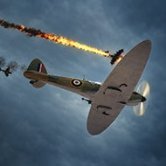
Sky On Fire : 1940
 (1 оценок, среднее: 5.00 из 5)
 Loading...
Similar Games












Description
You pull the Spitfire Mk.I into a hard right turn, hold it a second too long, and feel the airframe shudder as your speed drains away. The Bf 109 E-4 you were chasing is now the one sitting behind you. That three-second reversal is the real hook of Sky On Fire : 1940, a single-player flight sim set in the early war years where energy, crew positions, and patience matter more than a steady trigger finger. The low-poly look is deceptive, because the flying model underneath demands respect for how a wing actually behaves.
| Genre | Single-player flight simulation |
| Setting | Western Europe, 1940 |
| Playable nations | Germany, France, England, Italy |
| Aircraft | 18 types, including the Spitfire Mk.I and Bf 109 E-4 |
| Ways to play | Quick missions, linear campaigns, dynamic campaign, Workshop missions |
Dogfight Fundamentals in Sky On Fire : 1940
Most newcomers treat this game like an arcade shooter. They haul the stick back to the stops and chase every target in a tight circle. The airfoil-based physics punishes that habit fast: the wing stalls, speed collapses, and the aircraft drops a shoulder at the worst possible moment. Early in the game, during the first quick missions against a single opponent, the most useful lesson is to watch your airspeed instead of the enemy.
Each fighter pushes you toward a different style. The Hurricane Mk.I feels like a steady gun platform, and the Spitfire Mk.I rewards tighter, well-timed turns. The Bf 109 E-4 is happiest when you dive in, take one pass, and climb away, which players call boom and zoom. The Dewoitine D.520 puts you in the French cockpit, so switching nations changes how you fight and not only which roundel you wear. Veterans of other WW2 flight sims will recognize the energy fighting, even if the controls, whether on a joystick or a full HOTAS setup, take an evening to settle.
Check your six before you commit to anything. The AI opponents are persistent, and “on your six” is a sentence you will say out loud.
Controlling Every Crew Member: Bombardier and Gunner Stations
Multicrew is the feature that separates this simulator from most casual flight games. In bombers such as the He 111 H and the Ju 88, you can jump between the pilot seat, the bombardier, and the defensive gunners. You can even hand the controls to the AI pilot while you light up attackers on your six with a rear gun. Switching stations mid-fight feels clumsy for the first few sorties, and then it becomes the whole point of flying a bomber.
The Boulton Paul Defiant, a turret fighter of the era, shows why crew control matters so much. It pushes you to think about where the gun sits rather than where the nose points. A pilot who flies steady lines and a gunner who tracks the target are both you, and the rhythm between them takes real practice.
It is not flawless. Players report AI pilots flying into the ground at random, which can ruin a long bomber run, and handing over the stick stays a gamble until you learn how the AI behaves. Anyone who enjoys bomber crew roleplay will find the payoff, a tight overlap of defensive fire, worth the occasional mishap.
Quick Missions, Campaigns and the Dynamic War in Sky On Fire : 1940
The game offers four distinct ways to play, and they suit different moods. Some evenings you want a ten-minute dogfight, and others you want a campaign that remembers what you did yesterday. The structure covers both without forcing a choice.
- Quick missions for instant dogfights, ground attacks, and landing practice
- Linear campaigns that follow historical events and real squadrons
- A dynamic campaign where your results influence a larger simulated conflict
- User-made missions and campaigns from the Steam Workshop
Once you move from quick missions into the dynamic campaign, individual sorties start to carry weight, and losing a formation of aircraft actually shapes what comes next. Players who like a sense of consequence tend to settle here and stay for dozens of missions.
The mission editor stretches the game well past its built-in content. You can set up a one-on-one duel or a huge battle with dozens of aircraft, then use the photo mode to capture the result. Creators and screenshot collectors will find more to do here than the modest roster suggests.
Flak, Convoys and Bomber Formations
Intercepting a large bomber formation is where the pace of the game changes. Once the He 111 H formations close ranks, their gunners cover overlapping arcs, and a lazy pass from directly behind gets you shredded. Approaching from angles where fewer guns bear, and picking off stragglers, works far better than a head-on gamble.
Anti-aircraft fire during airfield assaults and anti-ship attacks looks sparse, yet what is there is accurate enough to surprise you. That mismatch between low volume and high accuracy is something you only notice after a few runs, usually at the moment a wing disappears.
Torpedo runs against ship convoys are the most nerve-testing missions in the game: low, straight, and slow, with almost no room to dodge. Ground-attack fans will love the commitment they demand. The roster of 18 aircraft is limited to 1940 western Europe, so some players wish for more types, but that tight focus is also what keeps the setting believable.
Questions Pilots Ask Before Their First Sortie
Which aircraft can you fly in Sky On Fire : 1940?
The roster has 18 aircraft from the 1940 western European theater, including the Spitfire Mk.I, Hurricane Mk.I, Bf 109 E-4, He 111 H, and Dewoitine D.520. The Boulton Paul Defiant, Bf 110, Ju 87, and Ju 88 are also in the lineup. Four nations are playable, but American types are absent because the setting stops at the early war years.
Can you control the gunners in Sky On Fire : 1940?
Yes, and it is one of the strongest features. You can switch between the pilot, the bombardier, and the defensive gunners in your aircraft. You can also let the AI fly while you man a rear gun against enemies on your six.
Does Sky On Fire : 1940 have a campaign?
It has two kinds. Linear campaigns follow historical events and real squadrons, while the dynamic campaign lets your results influence a larger simulated war. Workshop campaigns made by other players add more on top of that.
Sky On Fire : 1940 works best when you accept its pace. You earn every kill by managing speed in the Spitfire Mk.I, and every bomber run by trusting the gunners of your He 111 H to hold their arcs. The low-poly style lowers expectations, and the stalls, the flak, and the crew switching raise them again within the first hour.