












The Message From Deep Space
 (1 оценок, среднее: 5.00 из 5)
 Loading...
Similar Games












Description
You sit down at a retro computer in 1973, and somewhere above you a meteorite is broadcasting radio waves that nobody can read. The Message From Deep Space makes you the mission’s Translator, responsible for designing replies and slowly working out what an alien civilization is trying to say. There are no shortcuts, no tutorial that explains the language and no one who already knows the answer.
| Genre | Puzzle and investigation |
| Players | Single-player |
| Perspective | First-person |
| Setting | 1973, a meteorite broadcasting radio waves |
| Your role | The mission’s Translator |
| Inspiration | The Golden Record aboard Voyager I |
The Mission: A Meteorite, a Retro Computer and Radio Waves
The scenario is simple to describe and very hard to solve. Earth has received a meteorite that sends out radio waves, and as the Translator you design responses to its transmissions. If your response is correct, the meteorite answers with a new message. Through that exchange, patterns, words, syntax and meaning slowly begin to take shape.
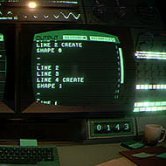
The mood is deliberately retro. You work at an old computer interface in a scientific team, and the whole game has the feel of a 1970s research project where every breakthrough is earned with paper-style patience. That atmosphere is a big part of why players call it surprisingly absorbing.
The central question never leaves the screen: what is it the aliens want to say? The game lets you chase that answer step by step instead of handing it over, and that restraint is the reason many players describe feeling like a real scientist.
How Translating an Alien Language Works in The Message From Deep Space
The language is deciphered completely from the ground up. You begin with the limited universal constants that any technologically advanced civilization would share, and the message then spreads across real-world fields of math and science. Players who enjoy puzzles that build on earlier discoveries will feel right at home.
The loop is send, listen and learn. You design a transmission, watch how the meteorite reacts, and use that reaction to form a better guess. Early in the game these guesses are small and cautious, but once patterns repeat, bigger ideas about syntax and meaning start to click.
Beginners often try to jump ahead and name symbols too quickly. The game rewards patience, because a wrong assumption can send you down a path that takes hours to unwind.
The Tools on Your Desk
Dictionary: The dictionary is user-driven, meaning you record what you believe each symbol or pattern means. It becomes your memory and your record of every theory, so keeping it tidy matters as much as making new discoveries.
Transmissions: You design radio transmissions by frequency, which is how you talk to the meteorite. Each transmission is a small experiment, and the response tells you whether your understanding is improving.
Retro computer: The computer is your interface to the whole mission. It ties together the dictionary, the incoming messages and your outgoing replies, and it gives the game its distinctive text-driven look.
The Team Behind the Translation in The Message From Deep Space
You never work alone. The mission’s scrappy band of scientists includes a meticulous linguist, a single-minded computer programmer and an affable astronomer, and they respond to what you do. More than a thousand in-game dialogues keep the team feeling alive as your theories succeed or fail.
Each specialist brings a different way of thinking. The linguist cares about structure, the programmer cares about logic and the astronomer cares about the signal itself, so you often hear three different readings of the same problem. Language-learning fans especially enjoy watching those perspectives collide.
The whole premise is inspired by The Golden Record aboard Voyager I, which explains why the message leans on real science and mathematics. It is a challenge fit for anyone with curiosity and perseverance, even if you are not a specialist.
Where the Challenge Divides Players
The game is long, with more than 30 hours of play, and that length is both its strength and its risk. Patient players love the slow reward of understanding a new idea, while others may find the pace demanding. Decoding is tough, and the game does not hide that.
Do you need to know math or science before starting? Not at all. The message begins with universal constants, so curiosity matters more than expertise, though people who like logic puzzles will progress faster. A demo is available on Steam, which is a good way to test whether the text-heavy, careful style suits you before committing to the full run.
The game is also in English only, with a mostly text-based, linear structure. That focus suits fans of investigation and puzzle adventures, but anyone craving action or flashy visuals will probably look elsewhere.
The Message From Deep Space turns a retro computer, a growing dictionary and a meteorite’s radio waves into one of the most absorbing puzzle adventures around. If you want to be the Translator who works alongside the linguist, the programmer and the astronomer to answer what the aliens want to say, this is a mission worth accepting.