














Slotbound
 (1 оценок, среднее: 5.00 из 5)
 Loading...
Similar Games












Description
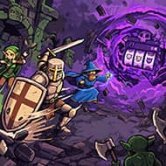
You pull the lever in Slotbound and the 3×3 grid settles on a line you did not expect, which means a unit you never planned around is now standing on your side of the field. That first spin sets the tone for everything that follows: nothing is fully chosen, nothing is fully random, and every result forces a decision about what to keep, what to feed, and what to risk next. It is a roguelike auto-battler where the slot machine is your recruiting office and the battlefield only rewards players who learn to read it.
| Genre | Roguelike auto-battler defense |
| Players | Single-player |
| Core action | Spinning a 3×3 slot machine to summon units |
| Campaign | Six stages with multiple difficulty levels |
| Progression | Permanent upgrades between runs |
Reading the 3×3 Grid in Slotbound
The grid is where every run begins, and beginners tend to treat it like a casino screen. They pull the lever, watch the symbols, and only care when something flashy lands. The better habit is to treat each spin as a recruiting call. Matching lines summon units, and a quiet result that hands you a second Warrior can matter more than a loud one that does not fit your army. Players who come from tower defense usually adjust fastest here, because they already think about coverage and composition instead of lucky streaks.
Then there is the jackpot, which is the reason people talk about this loop the way they do. A line that fills the screen can summon a legendary Prism unit, and when that lands during a run that was going badly, the swing is dramatic enough to feel like the machine is finally on your side. It is a moment worth remembering, but a run that depends on it is a run in trouble.
Early in the game, the most common mistake is spending every spin chasing that single payoff while the roster stays thin. A steady stream of ordinary units gives you material to absorb and promote later, and that material is what carries you once the waves stop being polite. Patience at the grid is quietly the strongest habit the game teaches.
Absorption and Promotion: Turning a 1 Star Warrior Into Something Stronger
There is no such thing as a useless unit on this battlefield, because weaker units can be sacrificed to feed stronger ones. That single rule changes how every spin feels. A duplicate you would normally ignore becomes fuel, and the unit that receives it grows into something with more weight in battle. Watching an ordinary 1 star Warrior ascend into a stronger form is the clearest example of why the loop stays rewarding even when the grid is stingy.
Promotion adds branching class choices, and this is where the army starts to look like yours rather than anyone else’s. Two players can begin with the same Warrior and end up with very different units depending on the path they select. Beginners often absorb whatever is closest and promote on instinct, then discover that their strongest unit is not the one their Items and Cores were meant to support.
Advanced players decide on a main carry early and feed it on purpose. Min-maxers in particular will want to protect that unit from careless sacrifices, because feeding the wrong body at the wrong time can undo several spins of planning. By the time you reach the harder stages, a focused army usually outperforms a wide one that never settled on a plan.
Random Stats and Imprints: Where Luck Becomes a Build
Every time a unit spawns, it rolls from dozens of Random Stats, which means two units of the same class are rarely identical. On top of that, each unit carries an Imprint that is unique to it. This layer is where the slot machine fantasy meets real strategy, because a roll that looks mediocre on paper can suit your build better than a flashy one. Learning to read those stats quickly is a skill the game never tests directly but constantly rewards.
It is also the most divisive part of the design. Players who love theorycrafting enjoy having rolls to interpret, while players who want a predictable roster may find it frustrating when a promising unit arrives with stats that do not fit. A run can feel unfair for a few spins, and the honest answer is that variance is built into the genre rather than hidden from you.
Before committing a fresh unit to your army, it helps to run a quick mental checklist, because rushed decisions at this point are the ones players regret around the first boss wave.
- Its Random Stats and whether they match the role you need
- Its Imprint and how it interacts with your current Cores
- The class branches it can promote into
- Whether it works better as a body on the field or as food for a stronger unit
Items and Cores: Bending the Odds in Slotbound
Items and Cores are how you stop being a passenger. Both exist to manipulate the odds, nudging the grid, the units, or the battle in your favor, and the strongest runs come from pairing them with the right units rather than collecting everything on sight. Cores are where the big synergy moments come from, the kind of explosive payoff that makes a build feel engineered instead of lucky.
Community talk around this genre leans on words like synergy and build, and both fit here. A Core only shines when the units around it support what it does, so picking up a powerful Core late can force you to rebuild your roster around it. That is not a flaw, but it does mean flexibility matters more than loyalty to your first plan.
Some players go further and hunt for system loopholes, bending randomness until the machine behaves almost predictably. Completionists who like to test every interaction will find plenty of depth here, while casual players can ignore the loopholes and still get far by keeping Items simple and letting one Core lead the army.
Judgement Waves and Boss Waves Across Six Stages
The six-stage campaign is where everything you built gets tested. Each stage brings different enemies, bosses, and mechanics, so a build that cruises through one stage can stall in the next. Judgement waves act as checkpoints that punish a thin army, and boss waves ask whether your units can survive a different kind of pressure rather than simply more of the same.
Multiple difficulty levels change how forgiving those checks are. Players who prefer a relaxed pace can learn the systems on the lower settings, while those chasing a harder challenge will find that every bad roll starts to cost something real. Either way, the game expects you to arrive at each boss wave with a plan, not just a pile of units.
Once a boss wave arrives, the spins you made earlier suddenly matter in hindsight. Units you absorbed, Cores you selected, and Items you passed on all show up in the result. That feedback loop is why a failed run still teaches something, and why permanent progression between runs makes the next attempt feel a little less hopeless.
Common Questions About Slotbound Runs
How does absorption work in Slotbound?
Weaker units are sacrificed to strengthen a stronger one, so duplicates and leftover bodies become fuel instead of waste. A 1 star Warrior, for example, can ascend into a stronger unit, and the class branch you choose during promotion shapes what it becomes.
What is the difference between Items and Cores?
Both are tools for manipulating the odds, but Cores are the pieces tied to the biggest synergy triggers, while Items add targeted help around them. Pair a Core with units that match its purpose before spending much attention on Items.
Is the slot machine only luck?
No. The grid decides what shows up, but Random Stats, Imprints, absorption choices, and Core synergies decide what you do with it. Players who plan around those layers can recover from poor spins and still reach the later judgement waves.
Slotbound rewards the player who treats every lever pull as the start of a plan: feed the right Warrior, protect the unit that carries your Core synergies, and arrive at each boss wave with an army that can survive the judgement waves before it. The grid will always stay unpredictable, but the army you shape from it does not have to be.