














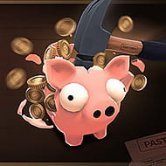
Bills Must Be Paid
 (1 оценок, среднее: 5.00 из 5)
 Loading...
Similar Games












Description
Bills Must Be Paid looks like a cheerful piggy bank smasher but plays like a stamina budget with a hammer attached. Every swing burns energy from your hand, every bill that shows up demands payment, and the run ends the moment you are too tired to keep smashing. It is a short active incremental game, and the pressure never really lets go.
| Genre | Active incremental |
| Core action | Smashing piggy banks with a hammer |
| Goal | Pay your bills and get debt free |
| Progression | Skill tree, hammer types, legacy points |
| Mode | Single-player |
Stamina, Swings and the Run That Ends When Your Hand Tires
Smashing costs stamina, and when your hand gets tired the run is over. That one rule separates the game from idle clickers, because you cannot walk away and let numbers climb on their own. Every swing is a small spending decision, so wasted swings cost you time inside the run itself.
Beginners usually treat stamina as if it were unlimited and swing at whatever is closest. The better habit is to aim for the piggy banks that actually drop money and let stamina upgrades from the skill tree stretch each run. Early in the game your runs are short enough that the difference shows up within a minute or two.
The money you collect feeds directly into your next attempt. Players who treat each run as a quick experiment, trying one tweak and then measuring the result, tend to grow faster than those who repeat the same routine.
Bankruptcy Resets and Legacy Points in Bills Must Be Paid
Bills show up on their own schedule, and ignoring them leads straight to bankruptcy. Paying a bill off unlocks perks that help you pay back your debts even faster, so the fastest way to clear bills is to prioritize them as they appear rather than saving them for later. That is the practical answer to how to pay bills quickly: treat every bill as an upgrade in disguise.
Paying bills also earns legacy points, and those points are spent on rings and bracelets that upgrade your hand after you declare bankruptcy. This is what legacy points are for, and it turns a bankruptcy from a failure into a reset that leaves you stronger. Players familiar with prestige systems will recognize the pattern immediately.
Once your first bill lands, the loop becomes clearer: smash, pay, collect legacy points, go bankrupt, and start again with better gear on your hand. The reset is not punishment, because the points you earn carry the run forward into the next one.
Hammer Choice and Skill Tree Paths That Shape a Run
Hammers come in different types, and they trade strengths against each other. Some have a higher crit chance with a smaller radius, while others are super fast with a big radius but deal less damage. When players ask which hammer is best, the honest answer is that it depends on whether you prefer precise, heavy hits or quick swings that cover more ground.
The skill tree has multiple paths, and the upgrades reflect the theme: improve your grip strength, get addicted to caffeine, hit the gym, pump up your wrist, or get more lucky. Optimizers will enjoy comparing paths, while relaxed players can simply pick what sounds fun and still make steady progress. Once abilities like rock rain and an electrified hammer enter the picture, the way you think about radius and damage changes.
No single path is clearly dominant, and that is a deliberate strength. Players argue over luck-focused builds versus stamina-focused ones, and both camps can clear their bills.
Piggy Types, Random Loot and Rare Coins
Piggy banks are not identical, and learning how each one behaves is a big part of mastering the game. The store description lists several kinds, and each rewards a different approach.
Runners are the piggies that run away. Chasing them burns stamina, so a hammer with a large radius or a fast swing helps you catch them without wasting effort.
Lazy piggies are too lazy to move. They are easy targets and a reliable way to bank money while your stamina is low.
Black money carriers hold the cash you never had. Piggies also spawn random loot, and you never know which one is holding the most, so rare coins and surprise drops keep every run slightly unpredictable.
What Players Debate in Bills Must Be Paid
The Short tag tells you what to expect: this is a compact game that rewards a few focused sessions. It has drawn a strong reception, with more than 5,000 English reviews at 96 percent positive, which suggests most players find the loop satisfying rather than shallow. Some players still wish for more content once they master the skill tree.
The loudest debates are about luck and repetition. Random loot can make one run feel brilliant and the next feel flat, and the core cycle of smashing, paying, and resetting can start to feel familiar if you play in long stretches. Short sessions suit the design far better than marathon grinding.
It is also, ironically, a game about your hand getting tired while your real hand does the clicking. Players who enjoy relaxed, quick incremental runs tend to love that tension, and those who want deep strategy may feel the ceiling arrives sooner than they would like.
Bills Must Be Paid rewards players who respect stamina, pay bills before bankruptcy forces the issue, and spend legacy points on rings and bracelets that make the next hammer swing count. Once your first skill tree path clicks into place, smashing piggy banks stops feeling like a scramble and starts feeling like a plan.