













Vilmonic
 (1 оценок, среднее: 5.00 из 5)
 Loading...
Similar Games










Description
You spend an evening pairing animatroids for a sturdier body, then toxic waste drifts near the group and the next generation comes out looking nothing like its parents. That swing between careful planning and happy accident is the rhythm of Vilmonic, a slow, strangely scientific sandbox where you are the last caretaker of the life that remains.
| Genre | Artificial life simulator and evolution sandbox |
| Perspective | Top-down |
| Players | Single-player |
| Platforms | Windows, macOS, Linux |
| Core activity | Breeding animatroids and fungols, crafting, digging up ancient tech |
How Genes Shape Every Creature in Vilmonic
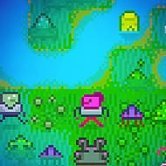
Every animatroid and fungol begins as a set of genes, and those genes do much more than pick a color. They control the bending of hidden bones or branches inside the body, and pixels are laid over that frame to form the shape you see. Because pixels and color carry meaning in this world, a creature’s appearance doubles as a readout of how it lives. Beginners often treat the art as decoration, which is the first habit worth dropping.
Animatroids are the creatures that wander, while fungols are the branching life forms you farm. Both obey the same genetic rules, so lessons from one group carry over to the other.
Behavior comes from the same genetic code. Each animatroid has a simple graph-shaped brain wired to three external sensors, motion, scent and water, plus three internal ones, hunger, stress and thirst. Attraction and repulsion between those sensors produce fear, aggression and attraction from simple gene-derived rules. Players who enjoy reading systems more than following quests will find that this is where the game really pays off.
Hydration, Nutrients and the Metabo Gene
Early in the game the most common stumble is ignoring body size. Each life form processes hydration and nutrients every metabolic cycle at a rate set by its metabo gene, and a larger body with more pixels needs more of both. A creature that looks impressive can quietly become the thirstiest member of the group.
Three things tend to catch new caretakers out. Each one is easy to miss until a favorite creature starts struggling.
- Large bodies need more hydration and nutrients every metabolic cycle than small ones.
- Wrinkled bodies have more surface area and lose more hydration to evaporation.
- The metabo gene sets the processing rate, so it matters as much as body size.
A player who loves tidy optimization will lean toward smaller, smoother bodies, while a collector chasing striking shapes has to plan water and nutrient sources around them. Neither approach is wrong, but each one changes what your animatroids need to survive.
Selective Breeding and Toxic Waste Barrels in Vilmonic
Natural selection and breeding are the only ways to evolve your life forms, and evolution is slow. Genes pass from parents to offspring with a chance of mutation, so the real work is choosing which creatures reproduce and watching what shifts across many generations. Patient tinkerers love this stage, and reviewers have noted that some players end up doing something close to real research and building on each other’s discoveries.
Toxic waste barrels are the shortcut, and they cut both ways.
Toxic waste drastically raises the mutation rate, which can open up new body shapes quickly and can also wreck a line you spent hours stabilizing. Sugary beverages are the milder route, since crafted drinks affect both your avatar and your pets, and the store page suggests drinking plenty of them to speed things along. Genetic engineering sits above both as the openly labeled cheat for anyone who wants a result now.
Haywire Zombitons and the Slow Middle Stretch
Once haywire zombitons show up, the mellow pace gets a jolt. They are mindless, and fending them off is part of keeping animatroids and fungols alive, which is why crafted tools and buildings start to matter beyond comfort. Each structure has an effect on the world, subtle or not, so defense and ecology end up tangled together.
Not everyone loves the pace. Reviewers call the game mellow and relaxing, and one player write-up noted that the visual variety is limited and the sandbox could use more inspirational goals once the tutorial ends. That is a fair complaint, because Vilmonic hands you a toolbox and trusts you to invent your own project.
Players who want a clear objective ladder can stall at this point, while those who like inventing their own experiments rarely do. Digging rivers and making new islands are among the ways to reshape the world, and they give self-directed caretakers something to aim at when no quest will.
Ancient Tech, Relics and Creature Cards
Beneath the surface sit relics, ancient tech and eons of buried trash that hint at the mysterious history of the planet. Some finds are useful and many are junk, so digging feels like a small gamble with your patience each time. Once relics start turning up, digging becomes a reason to explore beyond your first patch of ground.
Roads and a driving mode speed up long trips, which helps once your creatures and projects are scattered across several areas. Craftable structures and tools keep giving you reasons to carry materials with you.
Creature Cards close the loop. Any creature can be exported as a card, saved to your file system and dragged into another save, which makes it easy to share finds with friends. The store page adds a warning not to edit the genetic code on those cards, which says a lot about how seriously the game treats its DNA.
Common Questions About Breeding and Mutation in Vilmonic
How does breeding work in Vilmonic?
You choose which animatroids or fungols reproduce, and their genes pass to the offspring with a chance of mutation. Natural selection and selective breeding are the only ways to evolve new species unless you use genetic engineering. Expect changes to build up slowly across many generations.
What do toxic waste barrels do?
Toxic waste barrels drastically increase the mutation rate of creatures exposed to them. That can produce surprising new body shapes in the next generation, but it can also undo careful breeding work, so use them on lines you are willing to lose.
Can you share creatures with other players?
Yes. Export a creature as a Creature Card, save it to your file system and send it to a friend, who can drag it into their own save. Leave the genetic code on the card untouched, because the store page specifically warns against editing it.
Vilmonic rewards the caretaker who keeps asking why one animatroid thrives while another fades, and the metabo gene, the toxic waste barrels and the haywire zombitons give that question plenty of material. Start with a small group, watch how hydration and nutrients limit body size, and let the first strange mutation decide your next experiment.