














RV There Yet?
 (1 оценок, среднее: 5.00 из 5)
 Loading...
Similar Games












Description
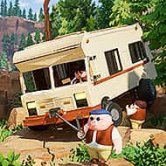
You roll the RV onto the ferry at checkpoint 3, unhook the front winch, and swim the cable across the river while three friends argue over proximity chat about which way the camper will tip. That is an ordinary minute in RV There Yet?, a co-op driving adventure where one battered camper has to cross Mabutts Valley and find the exit of Route 65. The goal fits in a single sentence, and the road spends every hour proving how little that sentence covers.
| Genre | Co-op physics driving adventure |
| Players | 1 to 4, all sharing one RV |
| Goal | Reach the exit of Route 65 |
| Main tool | Front and rear winch with a remote controller |
| Maps | Mabutts Valley, Mt. Yurbuttsk, St. Búttin Bay |
Winch Logic: Why the Cable Outranks the Engine
Almost every obstacle in Mabutts Valley is a winch puzzle in disguise. The RV carries one winch at the front and another at the rear, and each cable can be clipped to a tree, a rock, or a pole that you plant yourself. Once the line is anchored, whoever holds the remote controller reels it in and drags the whole camper over a ditch, up a slope, or across a gap. The role even has a name, remote commander, and one achievement is tied to reeling in 1 km of rope over a run.
Beginners treat the engine as the main tool and floor the pedal at every bump. The cable usually solves the problem faster than speed does.
The classic mistake is anchoring to something that only looks solid, which drags the RV sideways instead of forward. Park square to the edge before anyone reels, because an angled camper swings and rolls the moment the line goes tight. Wooden planks help too, since two or more laid across a gap give the wheels something to grip while the cable does the pulling. Planners who enjoy lining up angles will feel at home with this routine, while impatient drivers tend to learn it the hard way. A routine that works for most groups looks like this.
- Park the RV square to the edge of the gap and stop it completely.
- Plant a winch pole or hook the cable to a tree or rock on the far side.
- Lay planks across the gap if the wheels need something to grip.
- Hand the remote controller to one person and reel in slowly while the others watch the wheels.
Roles That Stop Four Friends Talking Over Each Other in RV There Yet?
Only one person drives, and everyone else works the terrain around the camper. Passengers walk ahead to clear the road and guide the driver across risky sections using proximity chat and the hand gestures built into the game. Because voices carry by distance, a friend who wanders far up the trail turns into a faint mumble, so gestures often beat shouting.
Most crews settle into four jobs: driver, navigator, winch specialist, and engineer. Swapping them at every checkpoint keeps the arguments short.
The engineer role matters more than it looks. Repairs call for engine oil and tools, and the RV has to be stopped before anyone starts working on it, so a driver who keeps creeping forward turns a quick fix into a disaster. Burgers, EpiPens, and antidotes sit in the same corner of the crew’s attention, and someone has to keep track of them before the next bad stretch. Quiet players who prefer one clear job usually end up as the engineer, and they often keep the run alive without anyone noticing.
Mabutts Valley Checkpoint by Checkpoint: Ferry, Cave Hell, and Abandoned Town
Mabutts Valley has 16 checkpoints beyond the starting spot, and the route begins at the eastern end before curling north around lakes and chasms. Progress is saved at each checkpoint, so a wipe sends the crew back to the last one instead of the beginning. That safety net changes how brave groups get, since a risky winch swing costs a retry rather than the whole trip.
Early in the trip, the ferry at checkpoint 3 teaches the cable lesson. The RV rolls onto the ferry, the front winch comes off, and a swimmer carries it to the far dock so the remote controller can pull everything across. The achievement for reaching it is called Can RVs swim?, which sums up the mood.
By the time you reach checkpoints 9 and 10, the valley turns into Cave Hell, and two separate achievements celebrate surviving it. Checkpoint 11 drops the crew into an abandoned town, and the final stretch after checkpoint 15 leans heavily on the winch to cross a river, latching onto a rock or tree on the far bank. Expect that last push to be slow and careful.
Wildlife, EpiPens, and Scrap: Keeping the Crew Standing
Wildlife is the other half of the danger in the valley. Bears and other animals can derail a run if a crew keeps driving and ignores them. Community guides advise stopping, dealing with the animal, and healing before moving on.
Supplies are the quiet currency of a run. Burgers, antidotes, EpiPens, engine oil, and scrap all compete for attention, and a crew that never counts them usually discovers the shortage at the worst possible bend.
- Engine oil and tools repair the RV, but only while it is stopped.
- EpiPens and antidotes patch up injured players, and one achievement asks for 20 EpiPens used.
- Scrap is worth hoarding, and another achievement tracks 100 scraps used.
- Mines can be set off on purpose, and the Mine Sweeper achievement asks for five blasts without taking damage.
Completionists chasing that achievement list quickly learn that stockpiling beats improvising. Restarting from checkpoint 3 is a popular way to farm the mine achievement faster.
Where RV There Yet? Goes After Mabutts Valley
Mt. Yurbuttsk sends the crew toward Route 65 again after a ski trip, this time through snow. It adds blizzard weather, inner tubes with a ski lift to bring them back up, a gondola section, vodka, snowball fights, and bridge puzzles that lean on planks and advanced winch work.
St. Búttin Bay is the beach trip home and the final map of the trilogy, marketed with the line One Last Ride. Coconut drinks and beach paddles are the new toys, and pushing a camper through water with paddles rarely ends well.
The game is not smooth for everyone. Reviews mention stutters on mid-range PCs, occasional multiplayer desync when many objects collide, and a shader compile at startup that takes a while. There is no pause even in solo play. Fans treat the wobble as part of the charm, while others see it as friction that costs them a good run.
Questions Players Ask Before Their First Run in RV There Yet?
How many checkpoints are in Mabutts Valley?
The valley has 16 checkpoints after the starting point, and some guides count the credits trigger as a 17th. Each one saves progress, so a wipe respawns the crew at the latest checkpoint rather than at the beginning. The last stretch after checkpoint 15 is built around river crossings that need the winch.
Can you play solo?
Yes, but there is no dedicated solo mode, because a solo run is simply you alone in a private room. The ferry at checkpoint 3 is the usual wall, since one player has to swim the winch cable across and then work the remote controller without a helper watching the RV. Four players share that burden far better.
Which map should you start with?
Start in Mabutts Valley, because it teaches the winch, the repairs, and the wildlife before anything else. Mt. Yurbuttsk adds snow and bridge puzzles that expect those skills, and St. Búttin Bay closes the trilogy with beach gear such as paddles and coconut drinks. Treat the other two as follow-ups once the crew can anchor a cable without arguing.
RV There Yet? lives on small, specific wins: a winch cable that holds, an EpiPens supply that lasts through Cave Hell, and a camper that finally reaches the exit of Route 65 with all four friends still speaking. Learn the anchor routine, hand the remote controller to the calmest voice, and let the jank become part of the story.