














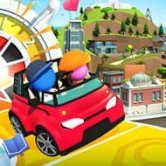
The Game of Life 2
 (Пока оценок нет)
 Loading...
Similar Games




Description
What changes when The Game of Life 2 takes the spinner-and-peg board you remember and rebuilds it as a 3D world with a crossroads waiting around every corner? Quite a lot, as it turns out, though the core loop of spinning, moving, and living a made-up life stays comfortably familiar. This game suits anyone who wants a relaxed turn-based session without the hassle of setting up a physical board.
The Spinner, the Peg, and the Life Path in The Game of Life 2
Every turn starts the same way: you spin the spinner and move your peg along the life path. There are no dice in this board game, so the spinner is the only source of movement, and its result is final. Early in the game that simplicity keeps the first few turns easy to follow, even for someone who has never opened a digital board game.
Your peg comes in pink, blue, or purple, and that color is only a marker, since the outfit and vehicle you pick are separate choices. The path itself is a road of spaces with career, relationship, and money events scattered along it. You are not racing to a finish line so much as building a life as you travel.
Each spin matters, but no single spin decides everything.
Crossroads: Where Early Choices Pay Off Late
Crossroads are the moments where the board stops being automatic. When you reach one, you pick a direction, and that choice reshapes your life path from there. Big career, relationship, and financial decisions can be made early or late in the game, which means there is no single correct order to follow.
Careers range from modern jobs such as Video Blogger to more traditional ones such as Engineer, and your pick shapes how you earn along the way. You can also adopt pets, which adds a lighter, more personal layer to the path. These details are small, but they make every life feel a little different.
Beginners often rush every decision toward the biggest paycheck, which ignores the fact that the game also scores happiness and knowledge. Players who like planning get the most from crossroads, because a decision that looks minor at the first fork can matter a lot by the time retirement comes into view. Skipping the thinking and just following the highest number is the quickest way to lose track of what you are actually building.
Wealth, Happiness, and Knowledge Points
Score is not just cash. The Game of Life 2 lets you collect points for happiness and knowledge as well as wealth, so a player with a modest bank balance can still come out ahead by chasing a different goal. Every goal counts as valid, and that changes how you read the board from the very first turn.
This is the biggest shift from the way many people remember the original board game, where money was the obvious measure of success. Here the question becomes what kind of life you want to finish with, and the scoring rewards whichever answer you commit to. Two players at the same table can follow completely different routes and both feel like they are winning.
Retirement is not necessarily the end of the road, either. You can retire to a luxury home or keep going, which gives the late game a decision of its own. Players who count every point carefully may take longer here than anywhere else, because the right call depends on how your three totals compare.
Classic City, Fairytale Kingdom, and Haunted Hills
The game offers three worlds. Classic City is the familiar modern setting, the Fairytale Kingdom lets you become a knight in shining armor, and the Haunted Hills put you in the boots of a Monster Herder. Each world brings its own outfits, vehicles, careers, houses, and items to unlock.
The honest complication is that availability depends on the platform. On some stores the Fairytale Kingdom and Haunted Hills come with the base game, while on others those worlds are sold separately inside the game, so checking the store page before buying is worth the minute. The Ultimate Life Collection adds 8 more worlds on top, and a Deluxe bundle packs the base game together with every world. Players who dislike add-ons tend to see this as the sore point of the whole setup.
The structure of spinning and choosing stays recognizable no matter where you play, while the careers, houses, and items change with the world. That keeps the learning curve flat even when the scenery gets strange.
Customizing Your Peg and Unlocking Outfits
Before each game you customize your peg, choosing among pink, blue, and purple, and then pair it with any outfit you have unlocked. You also pick a ride from the selection of cars, bikes, and scooters. Because outfits and colors are independent, you can build a look that has nothing to do with your peg color.
Playing earns rewards, and those rewards unlock new avatars, outfits, and vehicles. On the base setup the numbers are small: three outfits, three avatars, and two vehicles are open from the start, with another set of the same size waiting to be unlocked. Each new world adds its own cosmetics on top of that.
Completionists spend the most time here, since cosmetics are the long-term hook. Anyone who only cares about the points race can ignore the wardrobe completely and lose nothing in the actual game.
Where Luck Overrules Planning in The Game of Life 2
The spinner decides how far you move, which means you cannot plan for specific spaces. Players who prefer tight strategy sometimes find that frustrating, since a careful plan can be scrambled by a single unlucky spin at a key crossroads. It is the same tension that has followed spinner-driven board games for decades.
What softens the randomness is that the decisions are yours. You choose the direction, the career, and which goal to chase, so skill shows up in how you respond to the spin rather than in the spin itself. A player who adapts to a bad run often beats one who sticks stubbornly to an opening plan.
The game supports single-player sessions, local play for 2 to 4 players, and multiplayer matches for 2 to 4 players across platforms on supported systems. Families get the most from local play, since everyone can share a screen and talk through each crossroads together.
Common Questions About The Game of Life 2
- How many people can play at once? Up to four players can join a single game, either by sharing a screen in local play or through multiplayer matches that work across platforms on supported systems. Single-player is also available if you want to try different life paths at your own pace. Each player gets their own peg color from pink, blue, and purple.
- Can you keep playing after retirement? Yes, because the game lets you retire to a luxury home or keep going. That makes the late game a real choice instead of a forced ending, and the right answer depends on how your wealth, happiness, and knowledge points compare at that moment.
- Are all the worlds included from the start? Classic City is the base world, and the Fairytale Kingdom and Haunted Hills are either included or sold as add-ons depending on the platform. The Ultimate Life Collection adds 8 more worlds, and each one brings its own outfits, vehicles, careers, and houses. Checking the store page for your system is the safest way to know what you are getting.
The Game of Life 2 is at its best when a crossroads makes you pause: the Video Blogger job with a quick payoff, or the slower Engineer road that might pay off in knowledge points by retirement. Add a purple peg, a Haunted Hills outfit, and a table of friends arguing about luxury homes, and the spinner starts to feel secondary to the stories.