









GET UPSTAIRS
 (1 оценок, среднее: 5.00 из 5)
 Loading...
Similar Games








Description
You crouch by the last lamp in the basement, hand already reaching for the switch, and you know the second the room goes dark you’ll have to move fast and not look back. GET UPSTAIRS builds its entire game around that one specific childhood fear, stripping horror down to a single light switch and a staircase.
| Genre | First-person survival horror |
| Style | PSX-inspired visuals |
| Core Loop | Turn off the basement lights and reach the top of the stairs before something catches you |
| Session Length | Short, single-sitting |
Turning Off the Lights: The Entire Premise of GET UPSTAIRS
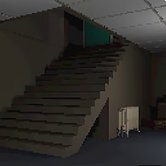
The mechanic is exactly as simple as it sounds. You’re in a basement, you need to flip off the lights, and then you need to get up the stairs before whatever lives in the dark reaches you first. GET UPSTAIRS doesn’t complicate this with inventory systems or puzzles; the tension comes entirely from the gap between flipping that switch and reaching safety.
That simplicity is deliberate, and it’s also the game’s biggest strength, since it isolates a specific, universally recognizable fear instead of burying it under mechanics that would dilute the feeling.
Players consistently describe this as the exact fear they had as kids turning off a basement light, and that recognition is doing most of the emotional work here.
The PSX-Style Look and Why It Fits the Fear
Visually, GET UPSTAIRS leans into a low-fidelity, PSX-era look, all soft textures and limited draw distance, and that choice ends up serving the horror rather than just being an aesthetic reference. Low visibility at the edges of the screen means you’re never entirely sure what’s in your peripheral vision, which keeps the climb up the stairs tense even on repeat attempts once you technically know what’s coming.
The grainy presentation also hides detail just enough that players fill gaps with their own imagination, which lines up with how the game treats its central threat later on.
The Creature Born From Your Own Fear
GET UPSTAIRS never gives its threat a proper name, and that’s intentional rather than an oversight. The thing that appears once the lights go out is described as something born of your own fear of the dark, which means the game is deliberately keeping it undefined so your imagination fills in the details the developer never committed to on screen.
This approach won’t land for every player. Some reviewers wanted a clearer sense of what’s actually chasing them, arguing that leaving the threat entirely unnamed occasionally undercuts tension rather than building it.
Once you’ve reached one of the game’s harsher endings, though, it becomes clear that the vagueness is doing real thematic work, tying the threat directly back to the player’s own imagination instead of a fixed monster design.
What First-Time Players Get Wrong
The most common beginner mistake is treating the run to the stairs like a simple sprint, when GET UPSTAIRS actually rewards players who pay attention to subtle audio and lighting cues during the climb. Ignoring those cues is the fastest way to walk straight into one of the game’s less favorable endings.
A second mistake is rushing the light switch itself before checking your surroundings, since a beat of observation before committing to darkness changes how the following seconds tend to play out.
New players also tend to assume the game plays out the same way each time, when small variations in pacing and player behavior are exactly what push a run toward one ending over another.
Multiple Endings and the Secret Ending Players Chase
GET UPSTAIRS offers several distinct endings, and reaching them depends on small variations in how you approach that same basic run to the stairs. Community discussion frequently centers on a secret ending that requires deliberately going against the instinct the entire game trains into you, and finding it tends to feel like a reward for genuinely understanding the game’s rules rather than luck.
Streamers and let’s-players often replay GET UPSTAIRS multiple times back to back specifically to collect every ending in a single session, since a full run takes only a few minutes.
Some of the most shared community clips focus specifically on that secret ending, since reactions to it tend to be more surprised than the more straightforward outcomes.
How GET UPSTAIRS Fits Into JoeTheItchPro’s Wider Catalog
GET UPSTAIRS isn’t an isolated experiment. The same developer has built a small catalog of short horror games around everyday childhood anxieties, including titles like Here Comes Santa Claus and GO TO BED, each one taking one ordinary household moment and quietly twisting it into dread. Seen alongside those games, GET UPSTAIRS reads less like a one-off idea and more like a refined entry in a consistent design philosophy.
That pattern is worth knowing if you enjoy GET UPSTAIRS, since the developer’s other short games apply the same restraint to different, equally mundane fears.
Post-Launch Patches and What Players Are Saying
Since release, GET UPSTAIRS has received small follow-up patches, including a fix aimed at players experiencing issues on Mac and a correction for a rare bug tied to pausing at a specific point in a run. Neither change altered the core experience, but both reflect a developer actively responding to player reports rather than leaving a short horror game to sit untouched after launch.
Player reaction has stayed consistently warm across comment sections, with many specifically praising how much dread the game manages to produce from a single, familiar mechanic rather than relying on jump scares layered on top of each other.
GET UPSTAIRS proves that a single light switch and a staircase are enough to build real dread, and once you’ve faced whatever waits in that basement dark even once, you’ll understand why so many players go straight back down to try it again.