














Beltmatic
 (1 оценок, среднее: 5.00 из 5)
 Loading...
Similar Games












Description
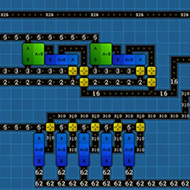
Beltmatic looks like a stripped-down factory game about conveyor belts, but it plays like a math course you can’t stop rearranging. Extract a number, route it down a belt, feed it into a building that performs an operation, and ship the result to the hub. That’s the entire premise, and it’s astonishing how much depth Notional Games squeezed out of something this minimal.
| Genre | Factory automation, puzzle |
| Developer | Notional Games |
| Release | March 29, 2024 |
| Core Loop | Extract numbers, transform them, ship them to the hub |
Extractors, Adders, and the First Real Wall
Every new save drops you onto an infinite grid with a hub in the center displaying your current Level and target number. Level 1 asks for nothing more complicated than shipping ten copies of the number 1, which extractors alone can handle once placed on one of the map’s highlighted extraction points. It’s an intentionally gentle opening, and it doesn’t hint at how quickly the game escalates once the adder unlocks.
The adder changes everything about how you think of the factory. Suddenly two extractors and a belt can produce numbers no single extraction point offers directly, and the shift from “shipping what I found” to “building what I need” is the first real conceptual leap Beltmatic asks of its players. Community vocabulary calls this moment the point where a run stops being a scavenger hunt and starts being an actual factory.
Beginners consistently underbuild during this stretch, running a handful of adders in a long chain when a compact grid of parallel adders would ship faster and use less belt real estate. It’s a forgivable mistake, since the game doesn’t punish inefficiency early, but it becomes a habit that’s painful to unlearn once multiplication enters the picture.
Why Multiplication Changes Everything in Beltmatic
Once multiplication unlocks, factories that took thirty buildings to reach a target number can collapse down to three. It’s less a new tool and more a demolition of everything you’d previously optimized, and that reframing effect repeats with every subsequent operation Beltmatic introduces. Subtraction, division, and eventually exponentiation each force you to reconsider numbers you’d already treated as solved problems.
Division deserves particular attention because of how it handles remainders. The division building outputs both a quotient and a remainder on separate belts, and that remainder isn’t discarded, it’s often exactly the value a different production branch needs. Recognizing that a “leftover” number is actually a resource is one of the clearer signs a player has moved from beginner to intermediate.
- Build parallel adder or multiplier arrays instead of long single-file chains once your target numbers grow
- Route division remainders into a second branch rather than discarding them, since they frequently satisfy other level requirements
- Use undo and copy-paste liberally, since Beltmatic’s factories are meant to be iterated on, not built once and left alone
The Long Game: Chasing Level 1000
Beltmatic’s map randomizes both target values and extractable number density, so the nearest 11 might sit five hundred tiles from your hub even while 1s and 2s are abundant nearby. That randomization forces route-planning decisions that differ from one playthrough to the next, which is part of why the community treats every new save as a genuinely fresh puzzle rather than a repeat of a known solution.
Players chasing the true endgame, reaching Level 1000, describe a very different kind of factory than the one they started with. One veteran player detailed reconfiguring their entire setup around a sequencer that injects controlled amounts of the next level’s number into a self-feeding duplicator array, producing hundreds of thousands of numbers automatically between injections. That’s an extreme end state, but it illustrates how far the same core mechanics can stretch.
Optimization-focused players tend to treat late-game Beltmatic as a pure efficiency puzzle, chasing the smallest possible footprint for a given output. Casual players, by contrast, are often content shipping a working but inelegant factory and moving to the next level rather than refining what already ships successfully. A third group, achievement hunters, care less about elegance and more about unlocking every building and reaching specific milestones regardless of factory tidiness.
Frequently Asked Questions
How long does it take to reach Level 1000 in Beltmatic?
There’s no fixed timer, but dedicated players who focus on efficient duplicator and sequencer setups report reaching the endgame well before casual players who rebuild factories from scratch at every level.
Does Beltmatic have combat or resource scarcity like other factory games?
No, there’s no combat and no perishable resources; the entire challenge is mathematical and logistical, centered on extraction, transformation, and belt routing.
Is Beltmatic comparable to Factorio or Shapez?
It’s frequently compared to both in community reviews, generally described as a gentler, lower-stress entry point into the automation genre that strips away resource management to focus purely on numbers.
Few games make repeated addition feel like a genuine “aha” moment, but Beltmatic manages it every time a new operation unlocks and half your existing factory becomes obsolete overnight. Whether you’re chasing Level 1000 or just trying to ship your next target number, the game keeps circling back to the same lesson: every number on the belt is a problem you already know how to solve, you just haven’t found the right building yet.