














Volley Random
 (1 оценок, среднее: 5.00 из 5)
 Loading...
Similar Games











Description
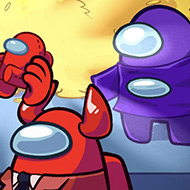
What happens when the court tilts sideways mid-rally and the ball you were lining up to spike suddenly drops at a completely different angle than it did three seconds ago? That’s a normal exchange in Volley Random, a game where the floor, the ball, and even the players themselves can shift shape between points. It’s built on a simple sport with a simple goal, and then it deliberately makes almost nothing about that goal stay the same for long.
| Genre | Physics-based sports arcade |
| Objective | Reach 5 points before your opponent |
| Controls | Single key to jump, kick, and spike |
| Modes | Solo vs CPU or local 2-Player |
| Best for | Couch matches and quick, chaotic rounds |
Ragdoll Physics and the Single-Button Spike
The control scheme in Volley Random is almost aggressively simple: one key does everything. In solo play, the Up Arrow handles jumping, kicking, and spiking depending on timing, while two-player matches split the load between W for one side and the Up Arrow for the other. There’s no separate button for blocking or setting — your ragdoll’s limbs flop and stretch based on momentum, and you’re reacting to physics as much as pressing keys.
This is where the ragdoll label earns its place in the name. Your character doesn’t move like a controlled athlete; it tips, overextends, and occasionally faceplants trying to reach a ball that curved away at the last moment. Players in the game’s community often describe good defense less as “blocking” and more as “getting your body in the way at the right angle.”
Precision matters less than positioning. A well-timed jump from slightly the wrong spot can still connect if the ragdoll’s arm happens to swing through the ball’s path, which is part of why matches feel looser and funnier than a standard volleyball game.
Courts That Change Mid-Match
Volley Random doesn’t keep the same playing field for an entire match. The court itself shifts — sometimes narrowing, sometimes tilting, sometimes swapping its surface entirely — forcing both players to adjust their spacing without warning. You can’t memorize a court layout the way you would in a traditional sports game, because it won’t look the same by the next point.
This constant resetting is the single biggest thing new players underestimate. Someone who’s used to planning a shot two seconds in advance will keep getting caught out by a net that’s suddenly taller or a floor that’s suddenly narrower than it was on the previous rally.
Once you’ve played enough rounds to recognize a handful of the recurring court variants, the randomness stops feeling unfair and starts feeling like a rhythm you can read — not predict exactly, but anticipate the range of what might happen.
Solo Mode Against the CPU
Solo Mode pits you against a computer-controlled opponent and works as both practice and a standalone challenge. The CPU adapts its positioning to the current court shape, so it isn’t a static target — it reacts to the same shifting floor and ball behavior you’re dealing with.
Players who prefer a slower, more deliberate pace tend to gravitate toward Solo Mode specifically because it removes the social pressure of a live opponent watching every ragdoll faceplant in real time.
Local Two-Player Showdowns
2-Player Mode is where Volley Random gets its reputation as a couch game. With W and the Up Arrow splitting control on one keyboard, two people sit close enough to genuinely see each other’s reactions when the ball takes an unexpected bounce. It’s a format the game’s community brings up constantly as the preferred way to experience the chaos — CPU matches are fine for practice, but the random elements land harder with a real person on the other side.
- Pick your side and get ready near the net
- Watch how the current court shape affects your jump range
- Time your key press as the ball approaches rather than jumping early
- Adjust immediately once the court or ball resets after each point
Ball Behavior Nobody Can Fully Predict
The ball itself doesn’t follow a fixed arc. It can spin oddly, bounce off a surface at a steeper angle than expected, or carry more speed off a hit than the swing looked like it should produce. Community discussion around Volley Random regularly circles back to this — people trading stories about a ball that “just didn’t do what it was supposed to.”
Common Habits That Cost Matches
Casual players tend to over-commit to a jump the instant the ball crosses the net, which works fine on a stable court and badly on a shifted one. More competitive players learn to delay that commitment by a fraction of a second, reading the court’s current state before reacting rather than relying on muscle memory from the last point.
- How do you play Volley Random with two players on one keyboard? Player one uses the W key while player two uses the Up Arrow, both controlling jump, kick, and spike actions on a shared court in local 2-Player Mode.
- Why does the ball in Volley Random bounce unpredictably? The game varies ball spin and trajectory by design, and combined with shifting court shapes, no two rallies play out the same way twice.
- How many points do you need to win a Volley Random match? The first player or team to reach 5 points takes the match, regardless of which court variant is active when that point lands.
Volley Random turns a familiar sport into something closer to a running joke about physics, and once the shifting courts and the ragdoll wobble stop feeling like a glitch, the five-point finish line becomes something worth actually fighting for.