






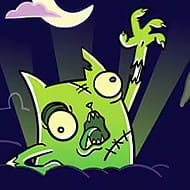
Zombie Kittens
 (1 оценок, среднее: 5.00 из 5)
 Loading...
Similar Games




Description
In Zombie Kittens you start with a hand of seven cards and one card in particular already in play against you: an unknown number of Exploding Kittens shuffled into the deck, waiting to end your turn if you’re not holding a way out. That single condition — draw wrong and you don’t just lose, you die and keep playing anyway — is what separates this game from the version most people already know.
Drawing an Exploding Kitten Without Actually Losing
The core loop of Zombie Kittens still runs on the same tension as the original: players take turns drawing from the Draw Pile, hoping not to pull an Exploding Kitten. What changes everything is the Zombie Kitten card. Play it the instant you draw an Exploding Kitten, and instead of being eliminated, you go Dead — a state that keeps you in the game rather than removing you from it.
Dead players lose their turn permanently, but they keep every card in their hand, and several of those cards can still be played against living opponents. This is the mechanic beginners misjudge most: assuming a Dead player is harmless is a fast way to lose a lead you thought was secure.
Community shorthand calls this being “zombified,” and experienced players track who’s Dead almost as carefully as who’s still alive, since a Dead player holding the right card can flip a game’s outcome without ever taking another normal turn.
NOW Cards and What Dead Players Can Still Do
- Dead players can play any card marked NOW at any point, even outside their own turn, letting them interfere with living players’ plans mid-turn.
- Nope cards remain playable by Dead players too, meaning a Dead player can still cancel another player’s action entirely.
- Dead players cannot be targeted by most cards that steal from a hand, which makes their remaining cards effectively safe from living opponents.
This creates a strange late-game dynamic where the living players aren’t just racing each other — they’re also managing however many Dead players are still lurking with cards in hand, ready to disrupt at the worst possible moment.
Bringing a Dead Player Back with a Zombie Kitten
Playing a Zombie Kitten does double duty: it saves the player who draws it, and it also brings one Dead player back to life, chosen either by the person playing the card or by house agreement depending on the group. The revived Exploding Kitten goes back into the Draw Pile rather than being removed, which means the danger that just got neutralized is still floating somewhere in the deck.
By the time a game reaches its later turns, the deck often has fewer cards but the same or greater concentration of Exploding Kittens relative to what’s left, since none of them are permanently discarded the way they would be in a simpler elimination game. Players who track this ratio mentally tend to make sharper decisions about when to draw versus when to stall with a Skip.
Carl and the Two-Player Mode
- Two-player games use only the cards marked with a Paw Print symbol, trimming the deck down to a smaller, faster-paced set.
- A ghostly third participant named Carl, represented by the game box itself, takes automatic turns drawing from the deck alongside the two human players.
- If Carl draws an Exploding Kitten, he automatically uses a Zombie Kitten to revive a Dead player, and if both human players end up Dead while Carl remains, Carl wins the game outright.
Once Carl appears as a genuine threat rather than a rules gimmick, two-player games take on a different texture — you’re not just outplaying one opponent, you’re racing a mechanical third player who never bluffs and never hesitates.
Cards Worth Saving Instead of Playing Immediately
What beginners get wrong early is spending useful cards the moment they draw them. A See the Future card burned immediately for curiosity is a wasted resource compared to holding it until a tense moment when knowing the next few cards genuinely changes your decision. The same logic applies to Dig Deeper, which lets you pull three additional cards from the deck — using it blind rarely pays off the way using it with a specific goal does.
How difficult the game gets as it progresses has less to do with rules and more to do with information. Early turns are mostly guesswork, but by the time the deck thins out, players who’ve been quietly tracking discards and played cards have a real statistical edge over players still drawing on instinct.
One thing longtime players openly debate is whether Dead players retain too much influence over the outcome — some groups love the chaos of a Dead player Noping a critical play at the last second, while others find it frustrating that a player who’s technically lost can still decide who wins.
Zombie Kittens earns its name honestly — dying here is rarely the end of your influence, and whether you’re holding a Zombie Kitten card, a stash of Nope cards, or just watching Carl take his next automatic turn, the game keeps every player, living or Dead, genuinely involved until someone finally stays down for good.