










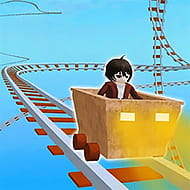
Rail in the Air
 (1 оценок, среднее: 5.00 из 5)
 Loading...
Similar Games











Description
Rail in the Air looks like a lazy sightseeing ride through the clouds, but it plays like a physics exam you didn’t study for. There’s no story, no cast of named characters, and no combat — just a wooden cart, a narrow track suspended above open sky, and the constant threat of gravity winning the argument. That gap between how calm it looks and how unforgiving it actually is defines the entire game.
The Cart and the Suspended Track System
Every run in Rail in the Air starts the same way: your cart sits on a narrow rail with nothing underneath it but open air. There are no guardrails, no safety nets, and no forgiving hitboxes. The moment your speed and the track’s angle disagree with each other, the cart leaves the rail entirely.
The track itself is the real antagonist here, since it’s built from stretches that escalate from manageable straightaways into steep drops and tight spirals with very little warning. Early routes exist purely to teach you how the cart handles before the game starts testing that knowledge under pressure.
Because the environment has no named landmarks or checkpoints beyond the track shape itself, players end up describing sections by feel — “the spiral before the long drop” becomes shorthand faster than any in-game label would.
Throttle, Braking, and Inertia in Rail in the Air
Acceleration is handled with the W key or the up arrow, and it’s deceptively easy to overuse. Holding it down on a downhill stretch doesn’t just speed the cart up — it builds momentum that the game’s inertia system carries forward into the next turn, whether you’re ready for it or not.
The S key handles braking, but treating it like a full stop button is a common early mistake. Braking in this game is closer to controlled friction than an emergency stop, and slamming it mid-turn can be just as destabilizing as not braking at all.
What beginners get wrong most often is reacting to danger instead of preparing for it. By the time a sharp curve is visible on screen, it’s usually too late to slow down cleanly — the adjustment needed to happen a few seconds earlier.
Reading the Horizon Before Committing Speed
Once you’ve fallen off the track a handful of times, a pattern becomes obvious: success in Rail in the Air comes from watching the horizon line, not the cart itself. Upcoming slopes and turns are visible well before you reach them, and players who glance ahead consistently outperform players focused on the immediate track under their wheels.
This is one detail that’s genuinely hard to explain without having played it — the game trains your eyes to shift focus upward and outward almost automatically after enough runs, in a way that’s hard to describe until you’ve felt the payoff of catching a hidden drop early.
The Dashboard and Respawn System
Dashboard: opened with the C key, it displays real-time performance readouts so you can monitor instability before it turns into a crash, giving attentive players a small early-warning system the casual player usually ignores. Respawn: the R key instantly resets your cart back onto the track after a fall, removing any long wait and keeping failed attempts fast rather than punishing.
That respawn speed matters more than it seems. Because falling is common even for skilled players, a slow reset would make the whole loop feel punishing rather than skill-based. Instead, the game leans into rapid retry as its core learning method.
Stage Progression Without Named Checkpoints
Rail in the Air structures its content as a sequence of stages rather than a single continuous track, each with its own layout and difficulty curve. Early stages teach speed control in isolation, while later stages combine steep drops with tight spirals back to back, offering almost no recovery room between hazards.
By the time you reach the later stages, the game stops introducing new mechanics and starts testing whether you’ve actually internalized momentum management from earlier ones. There’s no boss fight or final twist — just track design that assumes you’ve already learned the fundamentals.
Completing a stage unlocks the next one, and that’s the entirety of the progression system. Some players find that simplicity refreshing after more mechanically bloated racing games; others find it thin, and it’s a fair criticism the community brings up regularly when comparing the game to more content-dense alternatives.
Momentum on Downhill Sections
Downhill stretches are where Rail in the Air punishes greed most directly. Speed increases quickly once gravity takes over, and holding the throttle through a descent generates enough thrust to tear the cart off the rails within a fraction of a second if a curve appears unexpectedly.
Uphill sections flip the problem entirely — too little inertia going in and the cart stalls before reaching the peak, leaving you stuck rather than falling. Balancing these two failure states against each other is, in practice, the whole skill ceiling of the game.
Casual players tend to favor early, easier stages purely for the calm scenery, while more competitive players chase clean runs on the hardest downhill-into-spiral combinations specifically because of how unforgiving the timing window is.
Common Crash Points New Players Hit
The single most common failure point is holding acceleration into a curve the player hasn’t seen yet, especially on a first attempt at any given stage. The second most common issue is overcorrecting with the brake mid-turn, which destabilizes the cart almost as badly as excess speed does.
How difficulty changes as you progress isn’t about new obstacle types — it’s entirely about how little margin for error later stages leave you. A mistake that would be recoverable on an early stage is often fatal by the time spirals and drops start chaining together.
Long-time players eventually stop thinking about individual inputs and start thinking in terms of momentum management as a continuous flow, which is roughly the same shift skiing or downhill biking games ask of their players once the fundamentals click.
There’s no scoreboard flash or dramatic finale waiting at the end of Rail in the Air — just the quiet satisfaction of watching your cart clear a spiral you used to fall off constantly, C-key dashboard steady and the horizon already showing you what comes next.