






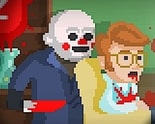
The Happyhills Homicide

 (1 оценок, среднее: 1.00 из 5)
 Loading...
Similar Games



Description
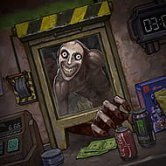
You take the call at two in the morning, same as every other complaint about scratching behind the drywall, and by the time you reach the client’s door in The Happyhills Homicide you already know this house is different. Rocky won’t stop growling at the frame. Something on the other side doesn’t want you to leave once you’re in, and it makes that clear fast.
| Genre | Point-and-click horror-comedy adventure |
| Controls | Left-click to move and interact, right-click to throw a held item |
| Structure | Four connected houses, each ending in a client case file |
| Companion | Rocky, a dog who follows on cue |
The Ghost-Response Job at the Center of The Happyhills Homicide
You run the paranormal-response outfit at the heart of the story, Overcursed Inc., and business has been steady enough that a haunted house barely raises your pulse anymore. Calls come in about salt lines gone stale, charms needing replacement, and bedroom walls scrawled with occult markings a client wants scrubbed. Most of it is maintenance dressed up as exorcism, and the game leans into that on purpose before it pulls the rug out.
The core loop is simple: you’re dropped into a two-dimensional cross-section of a house, click room to room, and pick up whatever the current job needs. There’s no traditional puzzle logic behind locked doors here, just objects to find and use on the one thing in a scene that’s actually interactive, closer to a scavenger hunt than a brain-teaser.
What players argue about first is pacing. The opening stretch is deliberately quiet, almost boring by design, and some have knocked it for feeling padded before anything supernatural happens. Others insist that slow client-service rhythm is exactly what makes the back half land as hard as it does.
Reading the Floors: the Cursor’s Drop Line
Movement is where The Happyhills Homicide trips up almost everyone in their first house. Each location is a sliced-open cross-section with floors stacked on each other, and a thin line drops from your cursor to show where your character will land. Click near a stairwell and that line can point to the wrong level entirely.
Players used to flash-era point-and-click adventures pick up the trick within a room or two; newcomers often spend their whole first house learning to trust the drop line instead of clicking on instinct. It’s a small interface detail that shapes how cautious or reckless a playthrough feels.
By the second floor of the first house you’ve usually already lost a minute to a misread click, backtracking down a hallway you didn’t mean to enter. That early friction is a common complaint in comment sections, right alongside praise for how the cramped floor layouts feel once you’ve got the hang of them.
Rocky, the Bone on a String, and the Company You Keep
Rocky isn’t flavor text next to your character portrait. Keep a bone on a string in your back pocket and he’ll trail you room to room, which matters because certain blocked passages only open once he’s physically there to nose through them. It’s a small companion mechanic, but it gives the houses a second character to react to.
There’s a specific sound cue players bring up often: the soft whine Rocky gives near a door he wants investigated, distinct from his normal following bark, which experienced players learn to treat as a hint rather than ambient noise.
What almost nobody expects going in is how much Rocky ends up mattering to the story’s late turn. The bone-on-a-string trick you’ve been using casually since the first house stops being a convenience item and becomes the emotional hinge the rest of the plot swings on, the exact kind of tonal whiplash that dominates player discussion threads.
Wards, Charms, and Clearing a Client’s Bedroom
Early jobs are almost administrative: replace a stale ward at the threshold, place a charm above a bed frame, wipe occult scrawl off a wall before it “spreads,” as one client puts it. None of it requires combat or reflexes, just noticing what’s out of place and matching the right item to the right surface.
Because there’s no conventional puzzle logic gating progress, beginners commonly get it backwards and pixel-hunt every room instead of working through the visible task list. The game rewards attention to what a client said on the phone more than it rewards blind clicking. Recurring job types across the houses include:
- Replacing salt lines and door wards that have gone inactive
- Placing protective charms in bedrooms and nurseries
- Scrubbing occult markings off walls before a case escalates
- Collecting and combining household items to reach a locked room
Early in the game these tasks feel almost too calm for a horror title, which is exactly the contrast the writing wants before House Four changes the rules.
House Four and the Wall of Scriptures
House Four is where The Happyhills Homicide stops being polite. A wall covered in scripture becomes the centerpiece obstacle, dense enough that it’s visibly tripped up several well-known Let’s Play channels, including Markiplier, on stream. It’s less a puzzle than a slower reading task layered on the usual item-hunting, and the tonal shift is immediate.
Difficulty here comes from denser scenes and higher stakes attached to the same clicking-and-carrying loop you already know, not harder mechanics. House Four asks you to slow down and parse what’s written instead of scanning past it, which catches out players coasting on autopilot.
“The scripture wall” has become shorthand players use in comment sections and walkthrough requests, a quick way to flag exactly where a playthrough stalled without explaining the whole scene.
What You Carry, What You Throw
Right-click throws whatever you’re holding, the closest thing to a combat option once something in a house stops being cooperative. Certain thrown items only work against certain threats, so trial-and-error done early pays off later when a job suddenly turns dangerous.
Inventory management matters more than the light framing suggests. Holding an item too long because you assume you’ll need it elsewhere is a common regret, since some objects are single-use and there’s no warning before you waste one on the wrong target.
Speedrunners who chain all four houses back to back keep a mental map of which item solves which scene ahead of time, rather than re-testing combinations on the fly the way a first-time player naturally does.
The Twist Every First-Time Player Gets Wrong
By the end of House Four, something reframes everything you thought you understood about Overcursed Inc. and why its calls keep landing specifically on your desk. The game calls itself a funny horror game the whole way through, and it mostly has been, right up until the moment it isn’t.
The reveal is built on details the earlier houses planted without drawing attention to them, which is why replaying the opening stretch after finishing hits differently. Small lines of dialogue and the Rocky mechanic in particular read as foreshadowing once you know where the story is headed.
This is the single most divisive part of the whole game. Some players call the ending a gut-punch that earns its build-up; others feel blindsided by how sharply the tone drops given how comedic the houses were up to that point. The developer’s own comment page carries well over a hundred posts arguing both sides.
Why The Happyhills Homicide Still Splits Its Players
On the sites where it’s rated, The Happyhills Homicide sits around the high three-out-of-five range, a strong showing for a two-day jam-scale project, and the number climbs when reviewers focus on atmosphere and Rocky over pacing complaints.
What keeps the discussion alive years later isn’t the ward-placing or item-throwing, it’s that ending. Newer players still ask in comment threads whether the dark turn was worth it, and veterans argue whether the opening houses were slow on purpose or just slow.
Horror fans who came in expecting jump scares tend to stay for the writing instead, and completionists chasing every client case find the houses reward a second pass once they know what Rocky’s really there for.
The Happyhills Homicide isn’t interested in staying the funny ghostbuster story it opens as, and once you’ve carried that bone on a string through all four houses for Rocky, House Four’s scripture wall and everything after it feel less like a twist and more like the game finally telling you the truth.