














Fart Together

 (12 оценок, среднее: 4.08 из 5)
 Loading...
Similar Games











Description
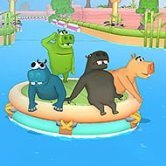
You and three friends are crammed onto one raft, somebody yells “left”, somebody else fires gas to the right, and the whole crew spins into the first wall before anyone finishes the sentence. That is a perfectly normal opening minute in Fart Together, a physics-based co-op parkour game where 2–4 players steer a single raft using fart power and nothing else.
| Genre | Physics-based co-op obstacle course |
| Players | 2–4 per raft in co-op, up to 8 in Team Race |
| Early Access content | Roughly 4–5 hours, depending on how well the team coordinates |
| Core skill | Matching direction, timing, and gas across the whole crew |
One Raft, Four Opinions: Steering in Fart Together
The central trick of the game is that nobody owns the raft. Every player adds force, direction, and timing, and the raft reacts to the sum of all those pushes at once. Gas is what you spend to move, and the way you aim it decides where the raft ends up. Four people pushing together do not create four times the control. They create a negotiation that has to be settled in under a second.
The studio’s own shorthand is “fart direction”, and it quickly becomes crew vocabulary too. New groups tend to treat gas like a throttle and hammer it as hard as possible, which is almost always the wrong instinct. The developers say it plainly: the secret is not farting harder, it is farting together at the right time. A crew with one natural captain who counts everyone in usually adapts faster than a crew where all four players give orders at once.
The team also admits the raft physics are only “sort of realistic”, and that admission is fair. Sometimes the raft flies off in a direction nobody can explain, and those are the moments when surprisingly scientific arguments break out between friends.
Narrow Passages, Sharp Turns, and Moving Obstacles
The courses ask for more as a run goes on. Early in a run there is usually room to drift, bounce off a wall, and recover, so the first stretches mostly teach you how much push each player actually adds. Once narrow passages and sharp turns begin to stack, drifting stops being an option. Moving obstacles then add timing on top of direction, so the raft has to arrive at the right place at the right second, not simply close to it.
- One player pushing the wrong way at a sharp turn can send the entire raft off course.
- Reacting too late to a moving obstacle turns a clean line into a collision.
- Everyone firing gas at the same moment, when the team actually needs to slow down.
- Overcorrecting after a bump, which usually costs more distance than the bump did.
Slowing down is part of the skill as well, and it is the habit beginners learn last. Sometimes the whole team has to speed up, sometimes it has to ease off, and sometimes everyone has to make the right move at exactly the same instant. Fans of precision platformers tend to enjoy that last case the most, because a perfect maneuver can rescue a run at the final second.
It is worth being honest about the rough edges. The game is launching in Early Access, and the developers openly say the difficulty curve, controls, and balance for different group sizes still need work. Expect a spike or two while the courses and tuning settle.
Coordination Habits That Turn Wrecks into Clean Runs
The crews that finish courses cleanly almost always develop a ritual. One player calls a short count, everyone fires gas on the same beat, and then everyone stops talking while the raft carries its momentum through the turn. Constant shouting during the glide is the quickest way to ruin it, because the next push arrives before the previous one has finished doing its job. Short bursts beat long ones in tight spaces.
Some groups also split the raft into a left crew and a right crew, so that steering a turn means one side pushes while the other side holds back. It sounds obvious, yet it removes the classic argument about who pushed too early. A friend with a questionable sense of direction, which the developers joke about directly, is much easier to live with once the job is defined as “you only handle the right side”.
There is a recognizable moment that players of this kind of game know well: the half-second of quiet right before a tight squeeze, when four people hold their breath and wait for the count. When the raft slides through clean, the celebration is louder than any win screen.
Team Race Chaos for Eight Players in Fart Together
Besides the classic co-op mode, the Early Access content includes Team Race. Up to 8 players split into two teams, each team takes its own raft, and both rafts run the same obstacle course with the finish line as the only goal. Everything you learned about gas and timing still applies, but now a mistake costs you the lead instead of only your pride.
Competitive groups will likely love how fast a lead can flip. A team that wrecks on a sharp turn can still win if the opposing raft hits a moving obstacle one second later, so nobody can relax until the line is crossed. Casual groups, on the other hand, may find that the pressure makes the shouting louder and the coordination worse.
Balance between teams of different sizes is exactly the kind of thing the developers have said they want community feedback on. If one team has a captain and the other has four captains, the result will not look like a fair fight. That is part of the charm, and also part of the risk.
Questions Players Ask Before Boarding the Raft
How many players can join a raft in Fart Together?
Each raft in co-op carries 2–4 players, and every one of them adds gas and direction to the same craft. In Team Race, up to 8 players are split into two teams, with each team steering its own raft through the same course.
How long does Fart Together take to finish?
The Early Access content is described as roughly 4–5 hours, depending on how well your team coordinates. A crew that keeps losing its line on moving obstacles and sharp turns will take longer, and Team Race adds replay time on top of that.
Does pushing harder help you steer better?
No, and this is the most common beginner mistake. Steering depends on direction, timing, and how many players fire gas at once, so a well-timed short push from the right side of the raft beats a long push from everyone.
Fart Together rewards the crews that stop shouting over each other and start counting down before they fire gas, whether that is a four-person raft working through narrow passages or a Team Race match with eight players. The moment a tight squeeze opens up and the raft glides through without touching a wall is exactly why friends keep saying one more try.