















Hell Deck

 (2 оценок, среднее: 3.00 из 5)
 Loading...
Similar Games











Description
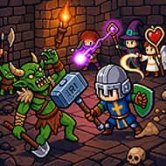
You wake up in the depths of Hell with a small hand of units, a cramped tile grid, and holy angels already descending to purge the abyss. One careless placement and your own formation starts eating itself. Hell Deck is a roguelike deckbuilder defense game built around exactly that tension, where survival is paid for in flesh and the battlefield behaves like a living ecosystem instead of a static board.
| Genre | Roguelike deckbuilder defense |
| Platforms | Windows, macOS |
| Mode | Single-player |
| Presentation | 2D / 2.5D, dark fantasy |
| Core mechanic | Ecosystem Deckbuilding on a restricted tile grid |
| Opposition | Holy angels and the holy swarm |
Ecosystem Deckbuilding in Hell Deck and the Logic of Predation
Most deckbuilders treat cards as disposable tools. Here, your units are living things on a restricted grid, and they hunt each other. That is the Ecosystem Deckbuilding mechanic: power is consolidated through cannibalism, so a unit that eats, or is sacrificed, feeds something bigger. Because the tile grid is limited, every round forces a choice between adding another body and protecting the synergy you already have.
Mutations are the payoff. Both accidental placements and deliberate sacrifices can trigger grotesque biological mutations, and that is how a weak grunt turns into an apex predator. Players call this the snowball, and the moment a cheap unit swells into something that clears a lane on its own is what keeps another run tempting after a loss. The game never asks you to simply stack stats. It asks you to engineer a food chain.
A single tile can decide the whole chain reaction.
Why Beginners Run Out of Space Before They Run Out of Angels
The classic beginner mistake is filling the grid out of fear. The holy swarm arrives in numbers, so the instinct is to drop every unit you hold. But each tile spent on a weak unit is a tile a later mutation cannot use, and a crowded board is also a board where your own units start preying on each other by accident.
Your hand and your inventory bag are the second trap. You can only place what you hold, and a unit kept in the bag is a decision with a timing cost, not a spare pocket. Strategy players who enjoy planning several moves ahead tend to settle in quickly here, since the game rewards deciding where a unit should stand before you draw it.
A few habits separate an early win from an early loss:
- Keep one tile open for the chain reaction you did not plan for.
- Hold back a strong unit until you know which neighbours it will end up eating or feeding.
- Treat every sacrifice as a purchase with a price, not as a loss.
How Hell Deck Pressure Builds as the Holy Swarm Thickens
Early in a run the angels arrive in manageable groups and almost any layout holds. The pressure comes from volume rather than a single trick. Once the holy swarm thickens, a board of unrelated units gets buried, and only a build with a real engine keeps pace. This is where the grid limit stops being a tutorial detail and becomes the whole challenge.
Experienced roguelike players will recognise the pattern. Commit to one engine early, then let sacrifices feed it instead of spreading your hand across three half-built ideas. The best moments come when one placement sets off a chain reaction that wipes out hundreds of oncoming enemies at once.
Not everyone loves how much chaos the game allows. Accidental placements can set off a mutation you never planned, which some players treat as the best kind of emergent surprise and others call unfair when it ruins a careful layout. The developers also disclose that AI was used only for minimal support material in unit design and partial localization, with the final assets drawn by hand, a detail some players care about.
What Waits in the Lobby After Every Death
Dying is part of the design. A mysterious, omniscient voice watches your failures and promises to fix you each time you break, and back in the lobby you unlock permanent upgrades that carry into the next attempt. That loop turns a lost run into information about which food chain collapsed and why.
Casual players with only a short evening can treat each run as a self-contained puzzle and still feel the lobby upgrades stacking up. The question the story keeps asking, why do you doubt this paradise, comes from the angels’ side, and it recasts the whole conflict. Here the angels are the apex predators and you are the prey trying to turn the tables.
That inversion is the hook. You are not storming heaven, you are surviving it, and the dark tone sits comfortably beside a grid puzzle about who eats whom.
Hell Deck rewards the player who treats every tile as a promise about the next mutation. Plan the food chain, sacrifice with purpose, and let the lobby upgrades carry what each failed run taught you, because the holy swarm never stops descending and the voice that promises to fix you will be waiting after every death.