





ROLLA
 (1 оценок, среднее: 5.00 из 5)
 Loading...
Similar Games


Description
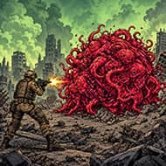
You roll over your first two civilians, the fleshy ball gains a little weight, and a soldier’s rifle immediately takes some of it back. That tiny exchange is the whole logic of ROLLA: eat to grow, get shot, shrink, and try to eat faster than the army can hurt you. Katamari fans recognise the shape of it at once, but the mood is closer to a B-movie where the monster is the one you control. The opening stretch feels like a harmless rampage, and then the helicopters start circling and the rampage turns into routing.
| Genre | Arcade horror destruction with twin-stick survival |
| Players | Single-player |
| Camera | Elevated, news-broadcast style |
| Structure | Six cities, each with its own missions |
| Platform | PC (Windows) |
| Input | Keyboard or gamepad |
Growing Fast and Staying Alive in ROLLA
The core loop fits into one sentence. You steer a sentient ball of flesh through a city, absorbing people, smashing cars and bashing through buildings, and every bit of mass you pick up makes the next target easier to swallow. That same body is also your health bar, which is what separates this game from the toy it borrows from. Bullets knock mass off, and once you shrink too far the run ends. Growth and survival are one number, so there is never a calm moment to simply enjoy being big.
Two tools keep that number healthy. The dash pulls you out of bullet lines and explosion zones, and the tentacle-like arms that sprout from your mass can grab nearby people for a quick size boost without rolling into them.
Points ride on top of the growth. Multipliers reward chaining destruction, and every mission scatters collectables and small objectives that push you toward riskier lines through the streets. Steam leaderboards sit behind all of it, so the same city can be a relaxed rampage on one run and a precise scoring exercise on the next. Score chasers tend to treat the grab arms as a combo tool rather than a rescue button, while players who only want to flatten tower blocks lean on the dash instead.
Why the First Runs End So Quickly
Almost everyone makes the same mistake at the start: they chase the biggest crowd and forget that the soldiers are the real clock. Rolling toward a cluster of panicking civilians feels right until you notice that every rifle in the street is now pointed at your widening silhouette. The army does not care how much damage you have caused, and each bullet that lands shaves off mass you worked to build. A first run can be over in a matter of seconds, and the next few are rarely much kinder.
Air strikes are the other early lesson. A direct hit is likely to end the run on the spot, however large you had grown, so spend the dash on the explosion rather than on the bullet stream.
The honest part is that some levels are unforgiving, and reviewers say so. Death comes fast and the restart is just as fast, which is exactly why the loop is so moreish: you almost never feel a failed run as lost time. Players coming from slower arcade titles should expect to spend their first sessions learning the rhythm of grow, dodge and grab.
Six Cities and the Mission Ladder
The full game is built around six city-scapes, each with its own set of goals, and you begin with only one of them open. Completing a portion of that level’s missions unlocks the next, which turns the whole structure into a ladder rather than a menu. Each level starts with six missions and opens six more once those are cleared. On paper the missions are repetitive, but they give every run a purpose beyond the score.
Missions come in a few familiar flavours:
- Devour a set number of people.
- Cause a set amount of damage.
- Knock down a set number of towers.
- Find the hidden letters that spell the name of the game in each level.
Surviving six minutes in a city triggers a nuclear explosion that ends the level, and the later missions usually ask for a bigger damage total plus reaching that point. Here sits the most debated rule in the whole game: second-wave missions you complete early do not count until they are unlocked. Once the first six are cleared, pushing on is pointless, so many players simply end the run and start fresh to make the new set count. It is a small annoyance, but it explains why some runs end on purpose.
How Helicopters and Missiles Change the Rules
Early in a run the danger is mostly bullets and a few flames, which you can outgrow by eating faster than you are being shot. Once the helicopters circle and the missiles start arriving, the maths changes, because damage now comes from above and in bursts. Bigger enemies join in after that, and the street stops being a buffet and becomes a fight. By that point a cautious roll toward the nearest crowd is no longer enough.
Smart players save the grab arms for these moments. Snatching people in a quiet corner restores size without exposing you to a firing line.
Advanced runs revolve around tempo. You stay in motion, dash only when an explosion is close, and pick fights with buildings while the army is busy elsewhere. Multipliers punish hesitation, so the best scores come from runs that never stop moving, even at full size. Leaderboard hunters usually share one habit: they treat the six-minute clock as a route to plan rather than a limit to survive.
Broadcast Camera and Damage Tally in ROLLA
The presentation is a joke that doubles as a interface. A news-report overlay tallies the destruction as you roll, and the camera sits high enough to look like footage from a helicopter. It sells the idea that you are the headline, and the chunky low-resolution look supports it. A thumping synthwave score runs underneath and gives every run a pulse.
The camera is also the most common complaint. As your mass grows the view is not always kind, and a huge ball can swallow the picture exactly when you need to see the next missile. It is forgivable because of the broadcast conceit, but it does cost some runs.
This game also works better with company than the genre suggests. Passing a controller around to beat each other’s score is a natural fit, and Steam lists it as playable on Steam Deck, with a keyboard-only option for everyone else. Fans of short arcade sessions will settle in immediately, while anyone hunting a sprawling story will not find one here.
Questions Players Ask Before Their First Run in ROLLA
How do you unlock the next city?
Finish a portion of the six missions on your current level and the next city opens. Each level then offers six more missions once the first set is done, so a city is not truly finished until both sets are cleared. Keep in mind that the second set only counts after it unlocks, so early progress on it is wasted.
What ends a run early?
Shrinking too far from bullets, flames and missiles ends the run, and a direct air strike can finish it in one hit. The dash is your answer to explosions, and the grab arms are the quickest way to refill mass between volleys. If helicopters are overhead and you are small, back off and eat before you fight.
Does it work on a controller or Steam Deck?
Steam lists partial Xbox and PlayStation controller support, and Valve rates the Steam Deck experience as Playable, meaning it works but may need some configuration. A keyboard-only option also exists. Small in-game text is the main thing handheld players notice.
ROLLA rewards the player who learns when to dash, when to grab and when to just keep eating. The six city-scapes, the nuclear flash at the six-minute mark and the helicopters hunting your mass give every run a clear shape, while the hidden letters and the second wave of missions give even a failed attempt a reason to restart. For anyone who likes high scores and a bit of B-movie carnage, this game is easy to start and hard to put down.